

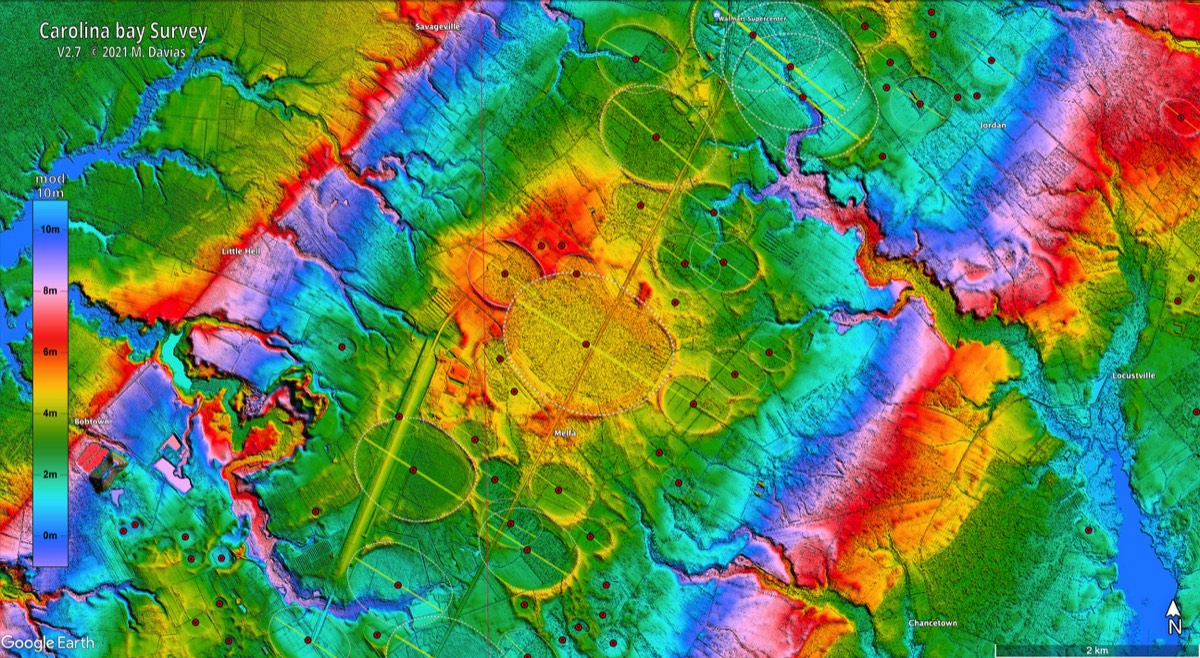

I've had a stroke, so only part of my brain is left , but... The volcanic eruption of 536 CE is described in Adomnan's "Life of Columba", which appears to have been constructed from an annal. That said, as we know from the Thera eruption, dust load from a volcano does not exclude dust load from a comet: The Poverty Point Thunderbird attests to this phenomena very clearly. We have the Tuscarora account of the Wizard's battle, but dating this will take money from the US Geological Survey to recover tsunami cores for the Carolinas. Where is the money? We have the Shawnee ancestral comet earthwork, which may refer to the Bald Mountains impact. But money for dating is necessary. Finally, I need to point out that neither of the Holocene Stat Impact Events dates to the Younger Dryas.
Deep Tusk Talk
5 archived comments · Oldest first
Visit the article and join the conversation →I left out this - We know Thera erupted in 1628 BCE, but from the tale of Deucalion we also know there was a comet close approach. As a matter of fact. the Thunderbird at the Povrerty Point earthworks was likely built in response to the climate collapse, which the people living there associated with the comet and not the volcano. What we are dealing with here is sorting out asteroid and comet impacts, a phenomenon affecting people which was entirely unknown to science in earlier times. There is something else which has been sticking in my craw for quite a while. Many people refer to the second of the Holocene Start Impact Events as the Younger Dryas impact, and are then surprised when professional geologists look at them like they are nuts, or very very sceptically. They do not know that several thousand years separate the second Holocene Start Impact from the Younger Dryas. I hope to see you at the bar at the next Geological Society of America meeting, where I hope to conduct a session on recent impact events. I am also available for select university lectures and roundtables
Hi Ed, We don’t know that Thera erupted in 1628 BC. In 1984 LaMarche and Hirschboek suggested 1627 BC (or the year before) as the eruption date for Thera based on a frost damaged ring observed in Bristlecone Pine. They suggested that the cause of the frost damage was due to the climatic disruption caused by Thera, because the radiocarbon dates for Thera by the mid-1980s were suggesting a 17th century BC eruption date. Then in 1988 Baillie and Munro also suggested that the narrowest ring event in Irish oak tree rings (beginning around 1628 BC), may have been the result of Thera. However, trees respond to the climatic effects of volcanic eruptions, but do not identify which volcano erupted. If we want to know the exact year for a volcanic eruption, then we either need to find its tephra in an accurately dated ice core layer or find a tree that has been killed and buried by that eruption, with the proviso that the outer ring of that tree still exists and that the tree rings can be precisely dated by some means. So far, no tephra from the Thera eruption has been identified in any ice core. Vinther et al. (2006) thought they had identified Theran tephra in a layer that they dated to 1641 BC in their GICC05 timescale (originally dated to 1645 BC), but this has been shown to be tephra from the large caldera forming eruption of Aniakchak in Alaska (Pearce et al. (2004), , Denton and Pearce (2008), Coulter et al. (2012)). Furthermore, due to the dating error in the Greenland ice core, this 1641 BC ice layer should actually be around 1628/7 BC, and so the Aniakchak eruption is most likely the cause for the 1628/7 BC climate event seen in northern hemisphere trees. Of course, this does not preclude the possibility that Thera also erupted that year, but there is no ice core evidence for it; either the evidence is not there in the ice layer, or Aniakchak is masking it. Now, until recently radiocarbon dating of organic samples from the Theran Volcanic Destruction Layer (VDL) have suggested that Thera erupted in the latter half of the 17th Century BC. The weighted mean radiocarbon date of an ensemble of 25 short lived samples (i.e. seeds) have given a range of 1664-1615BC (94.6% confidence) when calibrated against IntCal13 calibration curve. An olive branch, located in-situ within the Theran ash layer on Santorini, and reportedly living at the time of the eruption, can be radiocarbon wiggle-match dated against the IntCal13 calibration curve suggesting that its out ring last grew in the range of 1626-1606 BC (95.4% confidence) (see McAneney and Baillie (2019) for this and the following results). This is assuming that we have an accurate ring count of the olive branch. Olive trees are known to be tricky beasts, and can miss growth rings, or appear to put on multiple growth rings per year. In this respect it is sometimes best to assume we have no knowledge of the annual ring count and treat it as a sequence of radiocarbon dates within a Bayesian sequence. Doing so results in a date range of 1646-1611 BC (91.3%) for the outer segment when calibrated against IntCal13. These dates are in stark contrast to a mid-16th century date preferred by archaeologists, who base their dating on typological comparisons of pottery sherds and artifacts with other middle-eastern civilisations. Indeed, this is why obtaining a precise absolute date for the eruption of Thera is of such focus since it would provide a horizon for late bronze age middle-eastern chronologies, and why there has been such a debate over the low and high Thera dates between the physical sciences and the archaeologists. It now appears though that the debate may be on the way to being resolved. The latest iteration of the radiocarbon calibration curve, IntCal20, employs single year radiocarbon measurements across the 17th and 16th centuries BC. What is meant be single year measurements is that the radiocarbon age of a single tree ring of known age is measured, rather than a block of 5 or 10 rings of known age. When you perform the same calibration exercises on the short-lived samples from the VLD and the olive branch, but using IntCal20, we find that the short lived samples give a range of 1683-1653 BC (10.3%) 1642-1600 BC (57.5%) and 1585-1544 BC (26.3%). For the Olive branch, the date of the outer segment has been determined as 1625-1597 BC (71.5%), 1593-1560 BC (19.7%) and 1555-1546 BC (4.2%). So IntCal20 calibration now allows for the possibility that the eruption date was in the early-to-mid 16th Century. Manning et al. (2020), have performed more sophisticated modelling on the eruption date, by including it within the wider context of a larger Southern Aegean Bayesian Sequence (i.e. the eruption is embedded within a Bayesian sequence of radiocarbon dates across the late middle Aegean Bronze age). One model incorporates an 8 year radiocarbon age offset, while another does not. This offset may be required because the radiocarbon curve is derived from high latitude northern hemisphere trees (from North America and Northern Europe) which may experience slightly different growing seasons and carbon reservoirs with each other and/or to vegetation in the Eastern Mediterranean and Middle Eastern regions, which can become important on single year measurements (there is still quite a bit of debate over radiocarbon offsets; see Manning et al. (2020) for quite an involved discussion on the finer points of this!) . The model without the offset produced IntCal20 calibrated dates of 1619-1596 BC (72.6) and 1576-1545 BC (22.9%), while the model incorporating the offset produced the IntCal20 calibrated dates of 1612-1597 BC (8.2%) and 1584-1538 BC (87.2%). When you then compare these dates to the corrected Greenland ice core chronology (McAneney and Baillie (2019), Sinnl et al. (2021) , we see volcanic acid horizons around 1610, 1584 and 1560 BC. The Probability distribution of the calibration curves would suggest that either 1610 or 1560 BC would be the most likely candidates, however, Theran tephra has yet to be identified in either of these acid horizons. (see Coulter et al. (2012) and McAneney and Baillie (2019)). The point of the above is to show that while progress is being made on the true date of the Thera eruption (for example there is now a strong physical argument that it erupted in the mid 16th century, in better harmony with the archaeological typological dating), we still do not know the exact date. What we can now say though, is that Thera most likely did not erupt in 1628 or 1627 BC; recent radiocarbon analysis now appears to rule this date out (though perhaps not completely, hence why we say it most likely did not erupt in 1628/7 BC!), and that the climate event beginning around 1628/7 BC was caused by the large eruption of Aniackchak. References: Baillie and Munro (1988) https://www.nature.com/articles/332344a0 Coulter et al. (2012) https://www.researchgate.net/publication/233415186_Holocene_tephras_highlight_complexity_of_volcanic_signals_in_Greenland_ice_core Denton and Pearce (2008) https://agupubs.onlinelibrary.wiley.com/doi/full/10.1029/2007jd008970 LaMarche and Hirschboek (1984) https://www.nature.com/articles/307121a0 McAneney and Baillie (2019) https://www.cambridge.org/core/journals/antiquity/article/absolute-treering-dates-for-the-late-bronze-age-eruptions-of-aniakchak-and-thera-in-light-of-a-proposed-revision-of-icecore-chronologies/0E06053BFD90C1EA58ED8822814DC6F8# Pearce et al. (2004) https://www.researchgate.net/publication/37146718_Identifcation_of_Aniakchak_Alaska_tephra_in_Greenland_ice_core_challenges_the_1645_BC_date_of_Minoan_eruption_of_Santorini_Geochemistry_Geophysics Manning et al. (2020) https://www.nature.com/articles/s41598-020-69287-2.pdf Sinnl et al. (2021) https://cp.copernicus.org/preprints/cp-2021-155/ Vinther et al. (2006) https://agupubs.onlinelibrary.wiley.com/doi/full/10.1029/2005JD006921
Thanks for jumping back in Jonny!
Jonny McAneny 's discussion of Gregory's anecdotal account in the History of the Franks ' of islands in the sea destroyed [ presumably sometime in the 580's ] by 'fire sent from heaven " " We have here a report of the two islands being destroyed by fire from the sky . Gregory was told of this and he did not witness it himself ....[ He was told ] the lights in the sky that he [ had ] seen in October ...was the reflections of the islands being on fire . The implication then is the islands burned in October 585 but this may not be true " ......................." Here we have a contradiction though . The report says that the islands burned for seven days . If they were ignited by an impact event , which also caused a tsunami and were then submerged by a tsunami how did they remain burning for seven days " ? .Gregory recorded an anecdotal story [ probably based on a factual catastrophe ] in his annals and as anyone who has played the relayed game of 'telephone' understands , small details often are distorted in the retelling . Then there are the precise translations of Gregory's Latin to consider . He or other third hand recipients of the story may have been told the devastated islands smouldered for several days after a tsunami washed over much of the land area . An interesting cross comparison study is the 1347 CE destruction of Cyprus and the Mediterranean islands inhabitatants by a tsunami , earthquake and poisonous vapors recorded by Ziegler and Hecker . The sequence is somewhat anomalous with regard to that anecdotal report too yet the cataclysm almost certainly happened . We just do not know with certainty what caused it although Hecker mentions a meteor airburst The English historians Britton and Seller did record sea transgressions dated to the late 500's that may be of interest for further study in relation to Gregory's account . This is a compilation excerpted from Robert Does text " Extreme Floods' [ 2006 ] sourcing Britton [ 1937 ] and Seller [1696 ] : " East Anglia received a coastal deluge in 575 ,with similar inundations at Anglesea ...an island county of north west Wales in 580 . . There were floods around the North Sea during May 586 and then on the north east coast in 589 affecting Hartlepool." The Scilly Isles to the south of England is another candidate as the main island was split apart sometime in the 500's However we may not have sufficient information to determine if these events were storm surges or tsunamis . The florid 'vision' of St Columba passage you cited is of no relevance to this debate as a populous Italian city is recorded . Not islands in pastoral settings as per Gregory's version ....... .Moving the goalposts indeed.