


Hello for All Yes it's true, not far away, excavation (2011) on German small ponds structures gave evidence of very high temperatures in the form of intense melting an glass formation: matrix-rich breccia - multicolored small rock fragments in a sandy, silty black matrix. Some crateriform small structures from ten meters in diameter in young sediments in Southeast Germany have raised increased interest in the last decade, although they have been known since longtime. Its possible anthropogenic origin or simple sink holes origin were excluded, detailed rock-magnetic studies point to new ideas focusing on a formation of at least part of the craters are meteorite craters originating from the recently proposed large Holocene so-called Chiemgau impact event. http://www.chiemgau-impakt.de/wp-content/uploads/2011/12/Poster-Neumair-Ernstson.pdf Although the dating is not the same, has shown great amount of Holocene events. The circle is closing everywhere. From what I have observed in the field here in Brazil, some are Pleistocene, other Holocene, these small ponds seem cosmogenics. Very good!!! regards pierson
Elevated Iridium at Younger Dryas in England
20 archived comments · Oldest first
Visit the article and join the conversation →Hi folks Close there, I would venture to say that it seems that the prehistoric British left some possible record of this cosmic event: http://sites.google.com/site/cosmopier/impact-craters/holocene-palaeolagoons regards pierson
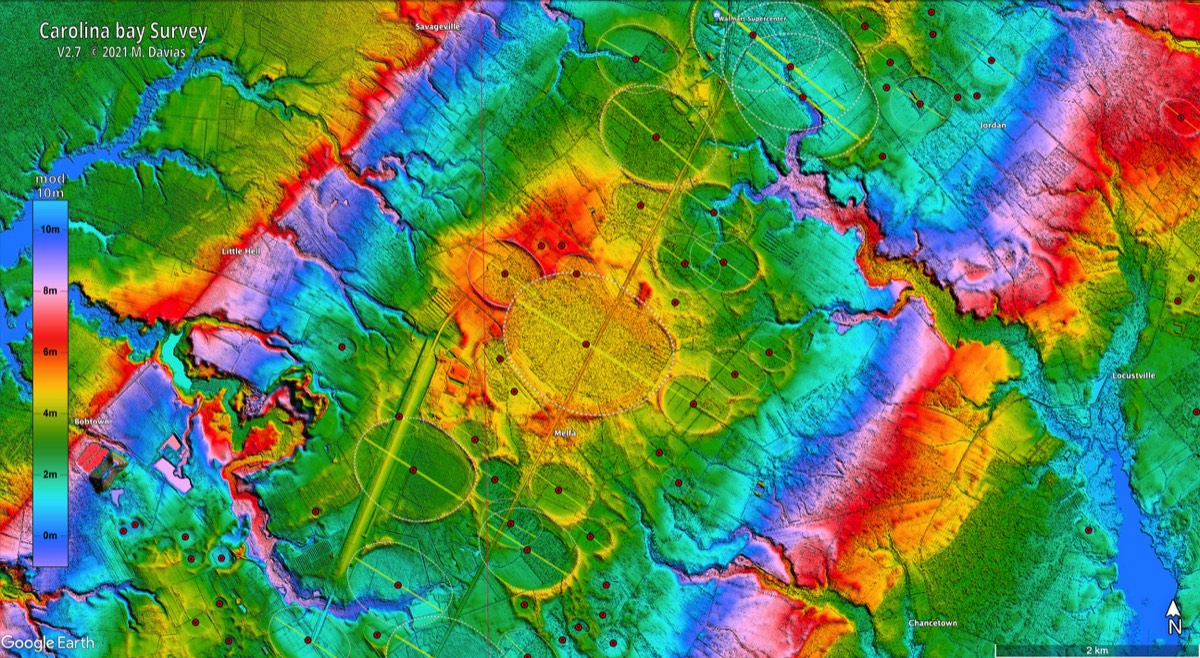
Pierson, Visiting your site linked in the post above is an image link to proposed elliptical basins on the Florida peninsula and the Bahamas. I wanted to note that they appear to align on the same locations as the Bays do in Davias' theory, Saginaw. Any lidar data sets available that may show morphology similar to Carolina Bays? Thanks
Hi folks The elliptical ponds can be identified in various regions of the world and certainly were not formed by secondary explosions, impact by ice glaciers. I myself have already identified possible impactites in several of them. They are probably very young, Holocene and Pleistocene, or even at different times, even from the same period, coming from the same meteoroids stream, and further complicates the investigation. http://sites.google.com/site/cosmopier/impact-craters/palaeolagoon-geometry The overlapping of dates is always a problem. However, the elliptic structures of Carolina Bays are very cryptic. regards pierson
Pierson - Not that it means anything, but in Sept 2009 I was in Aschau Im Chiemgau, just SW of the lake, trying to dig up information of an entirely different sort.
Hi Steve This is very interesting. For me in this investigative field all is important or may be fundamental in a short time. Please can you tell us a little about that dug information? It is still secret? Tell us something. regards pierson
Pierson - I was not saying "dug" as in excavated. I was researching a historical happening from the end of World War II. Sorry if that confused you.
Hi Pierson - While Schulz demonstrated tangential hypervelocity impacts with impactites at Rio Cuarto, (and you may have found some pending verification and publication)... That does not mean that every elliptical feature was formed by hypervelocity impact. Currently there have been no impactites found in the Carolina Bays.
Hi Pierson - Contact me and I'll send you a pamphlet about what is known about Serpent Mound. Sepent Mound was constructed by the Andaste people about 1,000 BCE. The Andaste were not in North America at the HSIE at 10,750 BCE, but it is fairly certain that comets did play a major role in the Andaste belief system. The effigy appears to represent the equivalent of the European constellation Draco, "source" of the Draconid meteors, centered around Comet 21P now. Comet orbital periods change with time. Serpent Mound was later re-used by Shawnee/Cherokee ancestors after they drove the Andaste out of the area, and its use was greatly modified. Watch out for making the mistake of conflating separate impact events. It appears impacts occured far more often than currently believed.
Hi EP Based on the model, the Carolinas Bays are consistent to a cosmogenic event. Anyway they are still mysterious. I am optimistic on the bet. The research continues! If everything had already been discovered, the game would lose grace. The field of Rio Cuarto is consistent with the cosmogenic model. But I also do not heard a lot about impactites there, just that Schutz presented... Do more impactites have yet to be discovered? Impactites seem to have a thousand faces. Information on prehistoric rock art has also indicated the possibility of a cosmogenic process for some of these structures. Every field visit I do on these palaeolagoons, I am more convinced that it is not only possible coincidence found ´possible´ impactite there. I may be a fool, but I'm not crazy. I think it is more statistical. So far, I'm 100% correct in the choice of structures visited. The type of soil, geology, and the possible combinations of physical characteristics typical of cosmic events, it is easier or more difficult to find any clues. Course the experience of the researcher in this new theme, should be de most important. I am empirical and I'm still giving my first steps. I try to support me in the past experience of other researchers. But I think I have been fortunate in my travels. I hope keep travelling this year. But it still has a lot to clarify, it is a collective work. regards pierson
I need a complete list of papers containing confirmatory evidence for the YD impact hypothesis to include in a Wikipedia edit. Anyone want to help me out on this one?
Hi EP Yes, true, the events seem to be very common and this is a problem, and also urges more. In some cases it is possible to associate the formation of the lagoon structures to prehistoric records and infer their age. In other cases it is possible to associate to fossils of megafauna, which also offer a clue to probable palaeolagoons age. The collection of impactites and such as stratigraphic studies, among others, are important to understand its possible genesis. Please, in the end of any COSMOPIER page you can find my e-mail, feel free send me more informations, when thou judgest relevant. regards pierson
Hi Pierson - The impactites Schulz's team found were bediasites, the whole given in the back and forth of the NATURE articles. The bediasites found had several geological ages, from multiple impacts, including the last tangential one. Thus the reinvestigation of the data led to a new impact discovery! They found no impact brecias at that time, as near as I can remember, but I'd have to go back and look at the articles. I don't know what all has been found there at Rio Cuarto recently, and you would know more about that than I would. There may be people/laboraties on the meteorite list that would be willing to help you with getting isotopic melt dates for your melt brecia samples. What ever happened to Oscar Turone?
HI EP Often the information that I receive are found by the general public in magazines or on the web. But keep some personal contacts with researchers. Yes I saw the article in Nature. And sometimes it is impossible to follow. If you have an article, a link, send me. Last month I kept in touch with Oscar Turone, he is in Argentina. He promised to send me a sample of Chapadmalal and Chasicó impactites, but until now still not arrived, they may have been lost along the way. The Argentines decided whom no meteorite should leave from the national territory, if any, it will be considered contraband, theft, punishable by imprisonment. Who knows if "my" impactite was intercepted? Or "confiscated" in Brazil? The bureaucracy here is also great for the output of any sample of Brazilian minerals.They are heavy identified and receive a seal, rocks of no commercial value, before putting them in the mail. In general, two days of work in public agencies, if employees are available, not in the field.. At moment I'm very curious about the increase of iridium research and prehistoric rock arts in Britain. Does it meet impactites there? And the palaeolagoons, some stratigraphy? http://www.rock-art-in-wales.co.uk/top/database.html regards pierson
Hello for all The prehistoric records on Barclodiad y Gawres are my favorites. http://www.rock-art-in-wales.co.uk/database/welsh-rock-art-barclodiad-y-gawres.html The lagoons and scarring in the region are also consistent with a cosmic event, is what I suspect. http://maps.google.com/maps?hl=pt-BR&ll=53.225189,-4.456698&spn=0.009879,0.013905&t=h&z=16 regards pierson
Hi Pierson - I am glad to hear Oscar Turone is still active in the field. The language in the Nature correspondence was pretty dense, and in academic Englsh, and I don't know if it was ever published in Spanish or Portugese. If you look up Schulz's co-authors, maybe one of them could help you with both translations and current work. Send a request to the meteorite list, as the laboratories may be able to help you with your mailing problems. We need a replacement for the Cambridge Conference as a rapid international clearing house for impact research and news.
Pierson - You might like the 360° panoramic views of Barclodiad y Gawres: http://www.megalithics.com/wales/barclody/barcpjs.htm If you pick on the blue spheres in the right window, you can get a different 360° panorama in the left window.
Hi Steve Yes, very good! The bas-relief with the (possible record of) plasma jets is right at the entrance. I was imagining a future intervention in the ceiling dome that were built to protect the rocks, with an expressionist not realistic painting depicting the cosmic event ........ a painting in the ceiling of the dome may be better than a sky of concrete. regards pierson
Scientists throwing water on our fire Well, dampness anyway :-) http://www.pnas.org/content/early/2012/04/16/1200296109
Has anyone seen this site-post? http://craterhunter.wordpress.com/2012/03/16/the-younger-dryas-impact-hypothesis-revisited/