
Pro Younger Dryas Impact Papers
150 Years Apart: New Swedish Evidence Challenges a Volcanic Explanation for the Younger Dryas
A newly published core from southern Sweden separates the Laacher See eruption from a distinct platinum- and microspherule-rich Younger Dryas Boundary fallout layer.

Sometimes the most useful contribution to a scientific argument is a piece of mud that keeps its events in order.
Christopher R. Moore and colleagues have produced just such a record from Körslättamossen, a fen in southernmost Sweden. Their new paper, published September 30 in ScienceOpen Research, places the ash from the Laacher See eruption below a separate layer rich in platinum-group elements, microspherules, and high-temperature melt products. The sedimentary change associated with cooler, wetter Younger Dryas conditions follows above.
For anyone tempted to sweep the Younger Dryas Boundary evidence into the volcanic dustbin, this is an awkward arrangement.
The volcano is below. The fallout layer is above. The Younger Dryas climate shift comes next.
Flip through the full paper
The complete 20-page published paper is available below. Scroll through the pages, jump to a page number, or use the zoom controls to inspect the figures.
Moore et al. (2026): Swedish Younger Dryas sediment record — full paper (PDF)
Read the paper · scroll inside the window
Three stages, one core
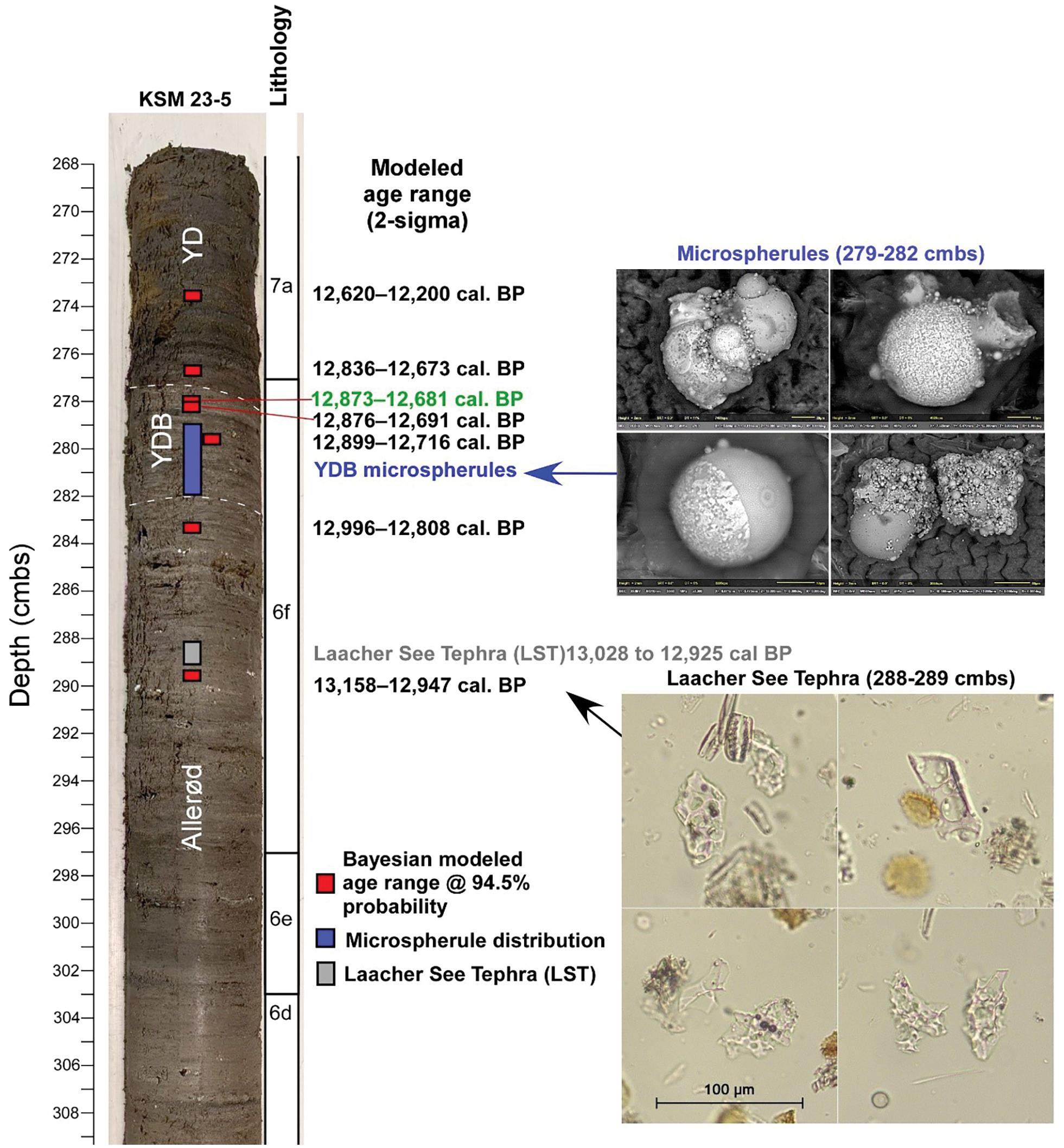
The attraction here is that the volcanic marker and the proposed impact-related fallout occur in the same sediment core, KSM 23-5. We are not trying to match a volcanic date from one continent to a mysterious particle layer on another. We can inspect their physical positions in one archive.
Read the sequence from the bottom upward, from older to younger:
The volcanic horizon is roughly 6–10 centimeters beneath the YDB interval. The difference between the adopted eruption age and the modeled basal spherule-peak age is 145 years: the approximately 150 years in our headline. “BP” here means before 1950, and these are calibrated calendar ages.
That interval is an estimate with uncertainty, not a stopwatch reading. The physical separation in the core is the first point; the chronology supplies the second.
Sweden supplies the comparison
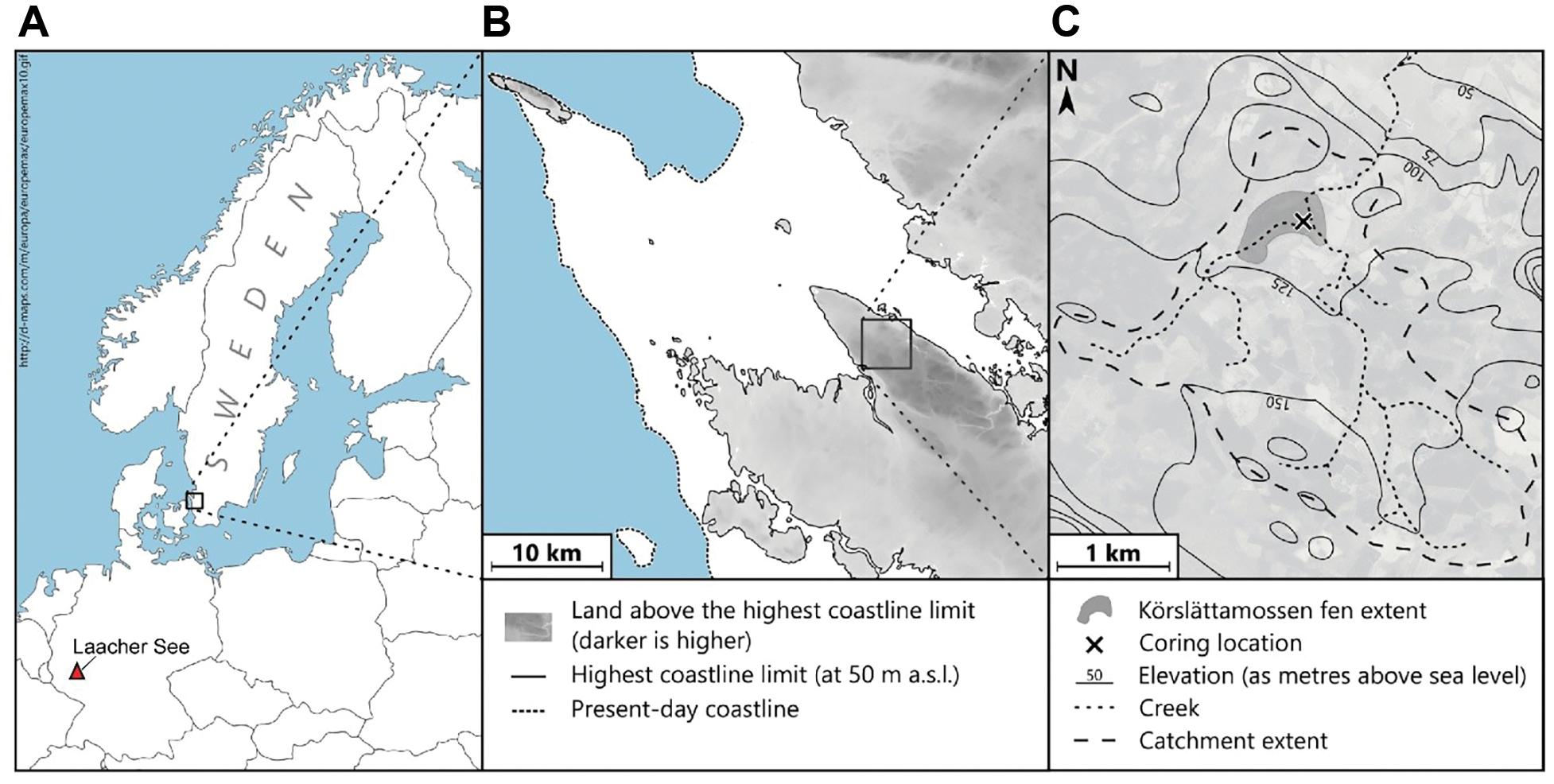
Körslättamossen lies in northwestern Scania, about 740 kilometers northeast of Laacher See in Germany. A former small lake beneath the present fen preserved the late-glacial sediment sequence. Earlier work identified the Laacher See tephra at the site; this investigation examines how a newly sampled core's particle and geochemical record sits relative to that marker.
The study reports no microspherules in the Laacher See layer. Between the volcanic marker and the later particle horizon, the authors also find an intervening interval without microspherules. The two deposits differ in chemistry as well as position.
That is the useful test. A volcanic explanation for this YDB assemblage must account for why the known volcanic deposit is lower, older, and chemically different.
Tiny particles, a distinct signal
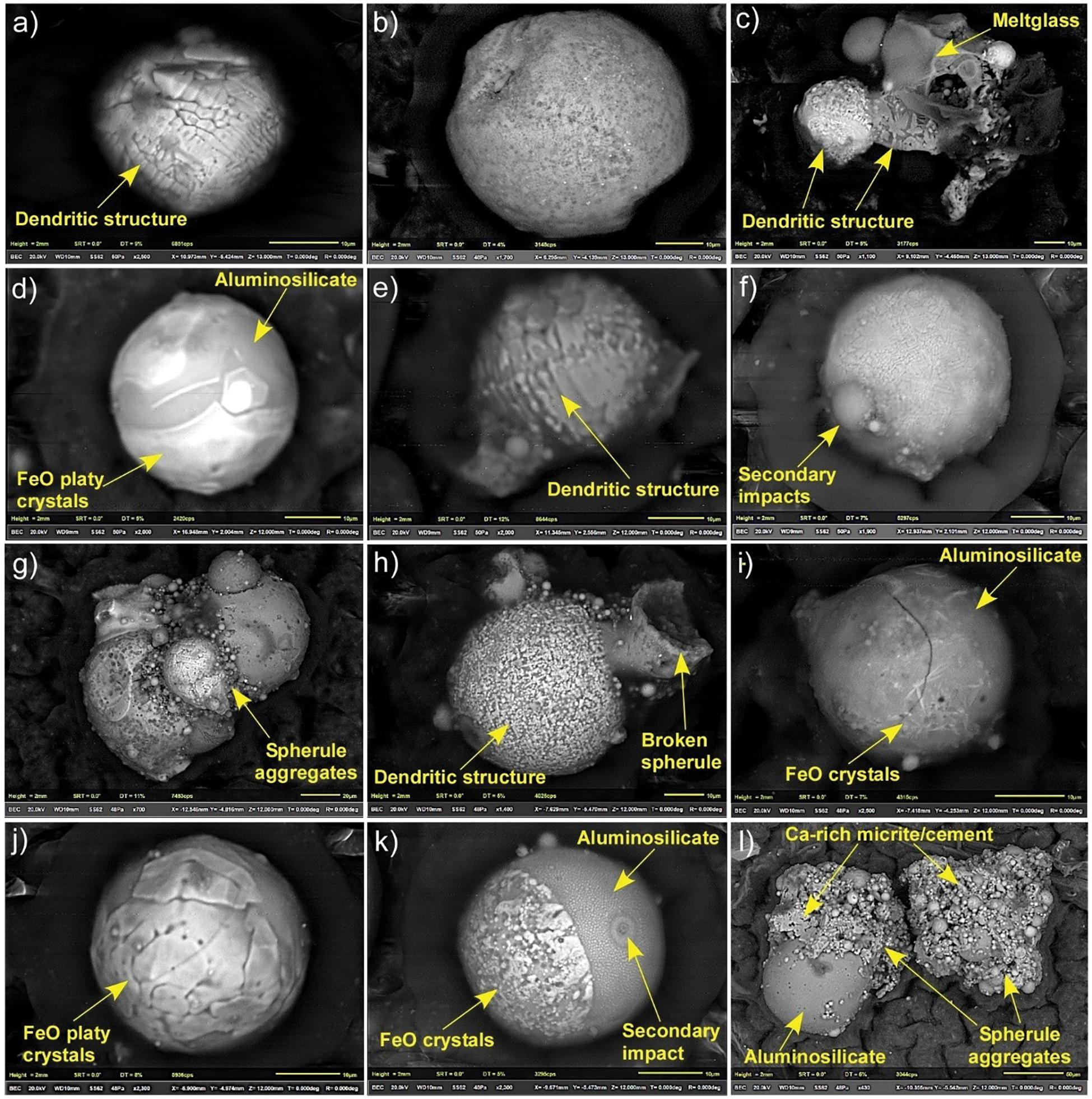
The microspherules peak at 282–281 centimeters. Electron microscopy reveals branching crystal patterns, fused particles, and meltglass—features the authors interpret as products of high-temperature melting followed by rapid cooling.
The maximum platinum-group-element-bearing nanoparticle mass occurs slightly higher, at 280–279 centimeters. The researchers interpret that internal offset as consistent with larger melt droplets settling before finer particles. The layer may therefore record deposition extending over decades; “fallout layer” does not mean every particle arrived on the same afternoon.
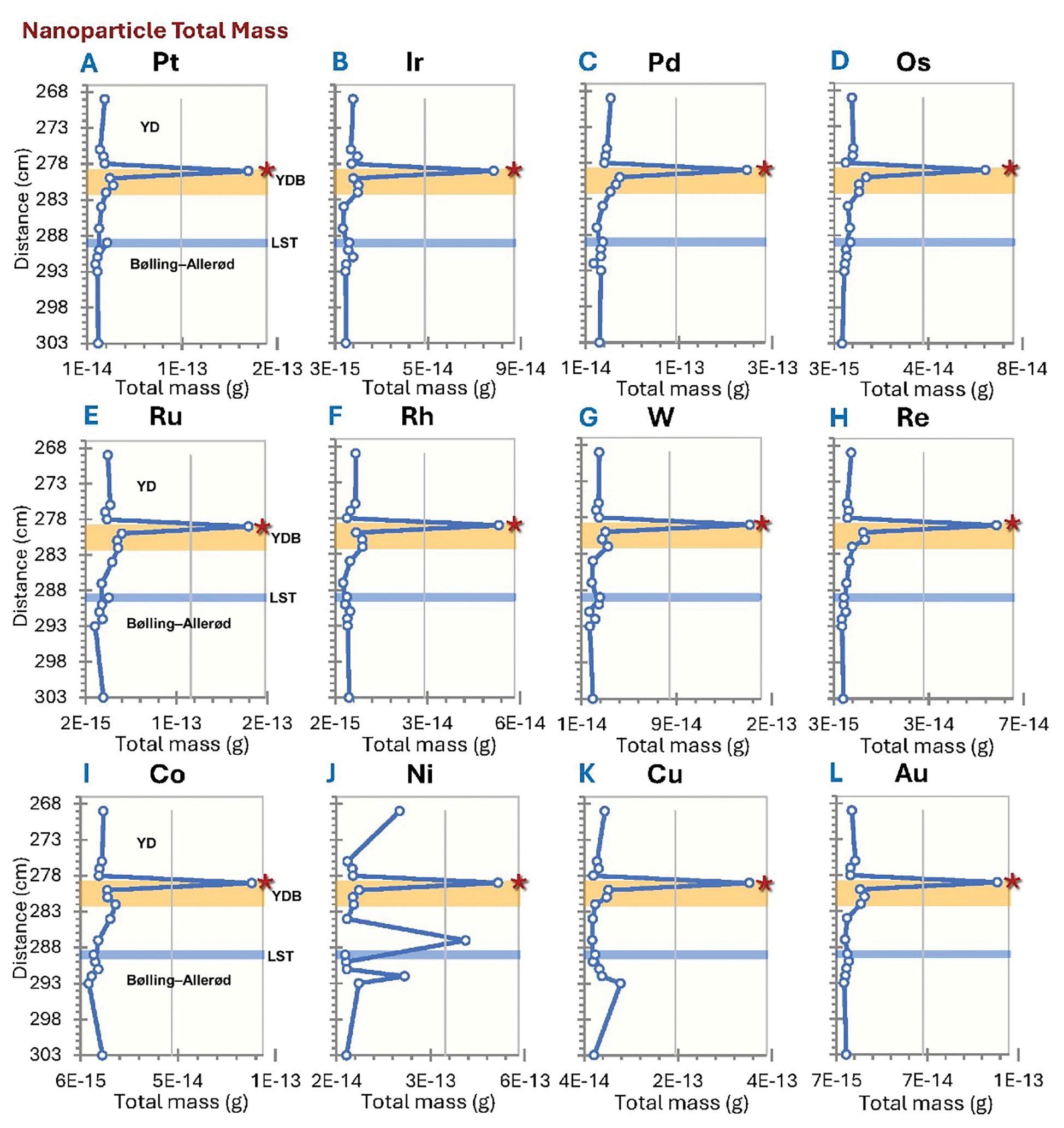
An important distinction: the microspherules are predominantly terrestrial material, according to the authors. Their argument for a minor extraterrestrial contribution rests on the combined particle and geochemical evidence, including PGE-bearing microdomains and nanoparticle compositions. These are not simply little meteorites sprinkled into Swedish mud.
What this does—and does not—settle
The paper challenges the proposition that the Swedish YDB proxy layer is simply fallout from Laacher See. The eruption left its own recognizable deposit. The later layer has its own particle assemblage. Then the core changes into darker, organic-rich sediments that the authors associate with cooler, wetter conditions.
The dating deserves attention, too. Bulk sediment radiocarbon ages required a substantial freshwater reservoir correction, and the age model uses both the independently dated tephra and a terrestrial leaf date from a correlated nearby core. The estimated separation depends on those chronological controls and modeling assumptions. “Comes next” describes the sedimentary order; it does not establish an instantaneous climatic response.
One core does not prove the Younger Dryas Impact Hypothesis, identify an impactor, or settle every proposed volcanic influence on climate. Nor does separation from Laacher See alone rule out every conceivable volcanic source. The authors favor a high-temperature fallout episode with an extraterrestrial component, and that interpretation remains open to testing.
But the local comparison is powerful. Anyone offering volcanism as an explanation for these particular particles now has to explain the actual sequence and its chemistry.
The Tusk welcomes that kind of argument. Put the layers, the dates, and the particles on the table. This Swedish core gives the discussion something wonderfully concrete to work with.
Read the paper
Title: Stratigraphic separation of Laacher See Tephra and a discrete Younger Dryas Boundary fallout layer in southernmost Sweden.
Authors: Christopher R. Moore, Simon A. Larsson, Mohammed Baalousha, Michael Bizimis, Mahbub Alam, Allen West, Malcolm A. LeCompte, James P. Kennett, Gunther Kletetschka, Julie Chouinard, A. Victor Adedeji, and Timothy Witwer.
Publication: ScienceOpen Research, e20260004. Published online September 30, 2026.
DOI: 10.14293/S2199-1006.1.SOR.2026.0004.v1. Publication and full text. Supporting information.
Figures retain the authors’ original labels, panels, and scale bars. Captions here summarize their findings for Tusk readers. The paper and reused figures are open access under CC BY 4.0; the banner displays the Swedish flag.