

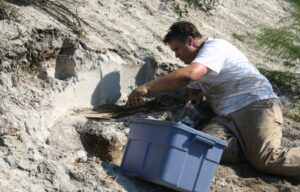
George Howard is an original proponent and widely cited avocational communicator on the Younger Dryas Impact Hypothesis (YDIH)—the theory that a cosmic impact event around 12,800 years ago triggered a global climate catastrophe, caused mass extinctions and spawned modern civilization. George has studied this theory, and its many implications, for over 30 years.
In 1998, George was contacted by Dr. Richard Firestone and Dr. William Topping after they discovered a 1997 essay he published online about the enigmatic Carolina Bays and their possible connection to a prehistoric global cataclysm. That connection laid the groundwork for the landmark 2007 paper published in the Proceedings of the National Academy of Sciences, which George co-authored with 23 other scientists. The study provided the first peer-reviewed physical evidence supporting the Younger Dryas Impact.
In 2015–2016, he led an on-site forensic investigation of an ancient burn layer at Tall el-Hammam, in the Jordan River Valley near the Dead Sea. The paper resulting from that study—though later retracted in a display of scientific cowardice—remains Nature’s most-read research article and presents compelling evidence that the site is the most viable (and ironically heretical) candidate for the biblical city of Sodom. George’s scientific work has now been cited in over 1,000 academic publications.
Frustrated by institutional resistance to the impact hypothesis, George launched the Cosmic Tusk in 2010. As a non-credentialed but scrappy advocate, he sought to expose the willful ignorance of legacy academia and document the slow-motion revolution in our understanding of cosmic catastrophes and human origins.
In 2015, George co-founded the 501(c)(3) Comet Research Group, serving as Co-Director alongside Dr. Ted Bunch and Dr. Allen West. In 2022, he founded Cosmic Tusk Productions, the for-profit entity that now produces the annual Cosmic Summit and related media.
George works with a global network of credentialed scientists—as well as a merry band of alternative history sleuths and speculators—exploring evidence of lost civilizations, impact events, and the suppressed truths of prehistory.
Following college at UNC, George worked for six years as a legislative aide for two senators in the United States Senate in Washington. In 1998, he founded Restoration Systems, an environmental mitigation firm based in Raleigh, North Carolina. The company became a national leader in compensatory mitigation banking and was successfully sold in 2022.
George is, by his own admission, a nerdy, overly-enthusiastic, and opinionated guy with a deep curiosity for obscure but important things. He is a frequent podcast guest, speaker, and commentator on the profound implications of the Younger Dryas Impact and the cosmic threats of our past—and future.
Yes, the Dryas should be related to a cosmic origin, as well many axis orientaded elliptical palaeolagoons worldwide.
I worked on prehistoric rock art and the possibles prehistoric registers for the Panela crater event (Brazil), for over 15 years. The investigations shows interesting informations, about the rock art of a meteor (it’s tropospheric explotion and the one that formed the crater) and the parallax of wiew from the sites where the painting are found.
http://astrofotos.info/main.php?g2_itemId=37534
Now I’m working in some possibles elliptical orientated axis palaeolagoons found worldwide, possible meteoritic relate event(s). There are hundreds of these shallow landforms in Brazil. My first contact with them was in June 2009.
http://astrofotos.info/main.php?g2_itemId=39482
The hypothesis is that some of these palaeolagoons should be of a cosmic origin, from the meteoroids of a defuct comet.
http://astrofotos.info/main.php?g2_itemId=41510
People worldwide would reported these events. The hyphotesis of meteors coming from the south and the parallax site wiew of the prehistoric registers appear to function as well for Rio Cuarto and some elliptical palaeolagoons in Africa.
The palaeolagoons could be as old as the End-Pleistocene.
http://astrofotos.info/main.php?g2_itemId=40514
I’m thanks in advence for your coments about these topics
yours
pierson
NEW! More about global mass extincion on 12,900 BPE, possibles craters and scars, palaeolagoons in Brazil.
http://sites.google.com/site/cosmopier/impact-craters/end-pleistocene-palaeolagoons
regards
pierson
Hi Pierson,
Those ‘palaeolagoons’ are very common in the southwest US as well.
There is much field work to do on them. But I’ve cataloged well over 800 of them in Arizona, west Texas, and new Mexico. There are a large variety of shapes to them. And many of them are squarish in shape. So I’ve been calling them square craters. You can find those photo galleries at, http://sites.google.com/site/dragonstormproject/square-craters
Many of them have the look of having been produced by a shaped explosive charge that detonated at, or very near the ground. And I don’t think they are impact craters in the normal sense. But I do think they are of ET origin. And I think they may be examples of the work of some of the explosive ices described by E.M. Drobyshevski.
See: Tunguska-1908 and similar events in light of the
New Explosive Cosmogony of minor bodies, http://dl.dropbox.com/u/2268163/Explosive%20Cosmogony.pdf
In a private email exchange with Bill Napier, he explained that while he couldn’t support the icy moon origin of the short period comets. The explosive, electrolized, ices Drobyshevski describes are still possible, depending on how long the object was orbiting in the solar wind.
You will find that many of those ‘palaeolagoons’ are a perfect mach for the two bowl craters Drobyshevski describes.
Hi Dennis
I have researched the subject to at least 15 years. I Identify the parallax view of the bolide passage in prehistoric rock art to the Panela crater. The same thing could be observed in rock arts for Rio Cuarto scars in Argentina and paleolagoons in South Africa.
But recently (2010) the prehistoric record that caught my attention was the Great Serpent Mound Geoglyph in USA. The Geoglyph reveals other possible related elipticall 60 km near structures in Ohio, and at 1,500 km structures in Florida and in the Bahamas Sea. http://sites.google.com/site/cosmopier/impact-craters/holocene-palaeolagoons
It also could confirms a south meteor shower oringin. http://sites.google.com/site/cosmopier/palaeometeorstream
Please feel free to make comments!
These events would been cyclical, millennial and global, maybe from 10,900 to 1,200 BC. They were catastrophic, caused large changes in the planet, but not so badly that an entire comet. After the catastrophe, the palaeolagoons were very important for the environment and social evolution.
I have no doubt that the Square Craters you found are relatives of South American, African and Australian palaeolagoons, scars and craters are countless.
Did you found any possible impactite in the ET-structures?
best regards
pierson
Hey guys. Just put up a link on the front page to the strange square bays of Bolivia. By the way, you may find using google map boxes helpful as well in your pages, communications and I think even comments. All you do just go to regular google maps, find your feature, and copy the “embed code” in the share section. Then past that into your pages. Helps folks put things in perspective.
View Larger Map
Yep! Google maps can indeed be placed into comments with just three clicks!
Just click “links” above the given map, and then copy embed…should assist Tusk discussions.
What tells us they are not wind-carved lakes?
I’m poor as a church mouse. So I haven’t been able to do anything to them but catalog them so far.
As for the wind doing it; that’s a fair question George. But how many times have you been asked that about the CBs?
Anyway, the answer is, because they don’t all have water in them. Many are only a burn scar. And they are found in a very large variety of target surfaces. I can’t figure out how to get the wind to make craters with square holes in the botttom.
With a little experimentation to focus the stream, and get the pressure just right, I can get a high pressure pulse of compressed air to make a crater that you can’t tell from a ballistic impact crater. Heck I can even hook up the power supply from a plasma torch in a steel shop and raise the temp of that pulse of compressed air to a plasma of well over over 10,000 degrees C. And give you a crater with some impact glass in the bottom to play with. Or I can take the voltage, and heat, still higher, and make a convincing crater using nothing but a high voltage, electric plasma discharge. But I can’t figure out how to get just pressure alone to burn a square hole in the bottom of the crater.
The square craters are something different that raises many questions. I have cataloged over 800 of them. As well as too many normal craters the size of football stadiums to count.
The images are in photo galleries on Dropbox.com of roughly 100 pictures each. Every image has the GPSs at the bottom of the image. And links to those galleries can be found at http://sites.google.com/site/dragonstormproject/square-craters There is also a short slideshow of them on that page.
After you’ve looked closely at a few hundred of them I doubt you’ll consider the wind as a suspect anymore.
But while you’re on that page, make sure you look at the gallery called ‘Crater fields’
Hi Dennis, George, folks
We must bear in mind that usually the smaller craters (paleolagoons) are often modified by human action. Some of them are enhanced in order to accumulate more water, others are used for mining. The larger basin can be damed, to supply cities. In the first moment, more important is to investigate the effects of shock on the target rocks, looking for impactites, or (stone) meteorites in the around smaller ones. I prefer to start my views on those larger than 100 m, outside the main drainage, and preferably virgin or lightly modified by human action.
Agreed, most of them are in cattle country. In the American Southwest, persistant drought is the rule of life. Any place that can be modified to store a little bit more water has been.
But with well over 800 of them already cataloged in New Mexico, and west Texas alone. And with too many normal round impact craters to count in the 100 meter diameter range, also cataloged, then when the funding presents itself to do a long road trip, and collect some specimens, there is no shortage of undisturbed sights to choose from in the American Southwest.
Hi George: I have not been in touch just lately (working on some other things). A few years ago now, there was an article or at least an abstract presented at the San Frnacisco AGU conference on some signs of cosmic impact in the North Pacific. Do you happen to have any further information on either who the researcher was or if there has been any further developments in that regard? Thank-you, Rod Chilton.
Hey Rod Chilton!
No I don’t have the article but sure hope someone who sees this does, and contacts you. I still feel guilty I never properly reviewed your great book.
Thanks for checking in.
GAH
Hi George: Yes, I really think the North Pacific may well be one of the locations where a large bolide struck the earth and created huge tsunamis that contributed greatly to the ice age mammal demise, at least in Alaska and Siberia (possibly South America? too). Yes, as well to the hope you might have been able to review my book. I did know you were an extremly busy guy, though and so I understood. I have to say sales have been extremely disapponting. In part this is due to me not being in the mainstream as far as this topic is concerned. I tried all sorts of journals to get more exposure, with what I thought was a slant that suited each, but no takers, as yet. Alas, I did become discouraged, it must be said. However, I do not want to bore you with this mundane stuff. But if any of your readers remember the scientist who I think presented a paper (poster or otherwise) at the AGU conference in San Francisco a couple of years ago I would be very appreciative. Take care George, and even though I have not been visitng your site just recently, I still think this is a very valuable forum!!!!!Please keep up the good work!, Rod Chilton.
Rod, North Pacific may well be one of the locations where a large bolide struck the earth
Nice idea, so that explains why the YDB team isn’t going to find an impact crater.
If, as Michael Davias believes, the Saginaw Bay impact is real and caused the Carolina Bays, that would precede the YDB according to E P Grondine, which I find all very confusing. But was it still in Bølling-Allerød??.
Hi Hermann: Yes I think the very larges (intact meteor(ite) struck the Pacific. However, that does not preclude that other smaller impactors also hit the planet (possibly too the Laurentide Ice sheet and yes Saginaw Bay ( I must check the Michael Davias reference (do you happen to have it Hermann? ) I think though there amy have been some comet and asteroidal activity (See Victor Clube and Bill Napier for the premsie of an extended onslaught from Space – something I do talk about in my book “Sudden Cold An Examination of the Younger Dryas Cold Reversal” incidentally. That may explain some other features like the Carolina Bays, if in fact they have been dated earlier than the Younger Dryas.
Rod, see your comment of May 26, 2010 on Cosmic Tusk
following George’s story about Michael which refers to his web site:
https://cosmictusk.com/perigee-zero-carolina-bays-in-the-midwest
Thank-you Hermann, you have a much better memory than I. I will check this out.
Hi Rod –
Since there was clovis culture use of the Carolina Bays (discussed earlier here at the tusk) they are far earlier than the YD event.
I think Lloydminster is a good YD geobleme candidate, as is Iltrude in South America. There will be another at one of the western glacial lakes.
Any more recent news of new data on the northward outflow of Lake Agassiz? Any news from the US-Canada Arctic Ocean survey team?
Ed,
Clovis Culture use of the Carolina Bays
You mentioned this in an earlier comment on the TUSK. Are any details about this available on the TUSK, or where can a curious guy like myself read up on this?
Hi E.P. Hermann, George and others: Just a few comments from me. E.P. you asked about any new data on northward flow from Lake Agassiz. The last reference I have was: J.B. Murton et al, 2010, Identification of Younger Dryas Outburst Flood Path from Lake Agassiz into the Arctic Ocean, Nature 464, 740-743. You are probably all aware of this particular reference. If not, the authors contend that a very large meltwater flux took place from the northern climes via the Mackenzie Drainage system. The problem is before this simulated flow would work both the terrestrial surface and the ice margin had to be adjusted (fudged????or is that a bit too harsh)? In any case, this adjusting process without very good reason does not impress me in the least. Also, I found the reference I was asking about earlier while reading through the summary of the Swiss conference(Dr. Sharma 2009). It is stated in the summary, that there are low OS isotopic ratios within the Mn materials, presumably extracted from the Pacific and Atlantic Oceans. It is stated further that this resulted from “post impact dust clouds” possibly over the Oceans. My particular view, is that there may well have been one of the larger bolides (at Younger dryas) striking somewhere in the Pacific that then lead to gigantic tsunamis. this may offer at least a part of the explanation for the massive large mammal die offs in Siberia and Alaska. Also,possibly some interesting massive mudslides in South America (in a usually very dry region) in what today is coastal Peru. George do you have the Sharma reference? Thanks.
Hi Hermann –
It was in one of the paper’s George linked to – perhaps if you google my name, clovis, cosmic tusk, and bays, google will direct you to the right post here.
Hi Rod –
I am pretty confident that Algonquin ancestors survived the YD on the Pacific Coast of Canada, so I am pretty sure that we can rule out impact tsunami opening the Bering Straits. It would be nice to get some 14C dates on the Fairbanks bone deposits.
I was hoping that the paper at Berne would give more data. We also should have the Canadian_US arctic reports pretty soon.
Does anyone have the GSA meeting schedule yet?
George, CL’s back.
Hi George: I wonder if you might wish to see a paper I am completing on the large number of ‘other factors’* that indicate both the fallacy of the THC hypothesis, while at the same time reinforcing the cosmic cause for the Younger Dryas?
* by other factors I mean all those not encompassing nanodiamonds and microspherules. The debate to date has not been all encompassing.
Love to see it, Rod, and happy to post when you like. Please forward!. Good to see you are still around.
Thanks George, yes I am still alive and kicking. I will send along the paper to you early next week, as I am just going through the final edit. Steve Garcia kindly helped me in doing a very fine and very thorough edit. Interestg about both the Mexican and also the Great Alaska wave don’t you think? Cheers, Rod
Hi again George: I have that paper I was telling you about ready for your perusal. I would be pleased to mail it to you or send by electronic mail. I do think you may wish to see if is appropriate for this site (as it attempts to cover a lot of ground, not all to do with impact markers).
Hi George: Hope this is O.K. to try and send my paper via this route, if not please advise.
THE YOUNGER DRYAS – THE REST OF THE STORY
Author: Rod Chilton, http//www.bcclimate.com
ABSTRACT:
The genesis of the Younger Dryas stadial (cold interval) remains an enigma. The onset was both climatologically unexpected and extremely sudden. The two principle theories are diametrically opposed and the proponents of both deeply committed. The debate to date has primarily been centred on some unusual “black mat’ deposits that may or may not be linked to a cosmic origin. What has been lacking in the wider discussion are all the other important features associated with the Younger Dryas. The following addresses many of these in hopes of their inclusion in future debates.
AND NOW THE REST OF THE STORY:
The Younger Dryas onset remains a little understood event. The cause of the 1,300 year-long interval continues to be debated. There are two completely different theories that have split the scientific community. One group strongly endorses an overall slowing or complete stoppage of the Northern Atlantic Ocean circulation 13,000 years ago. The other camp maintains that a catastrophic event originating from the cosmos was the cause.
Following on the heels of the mostly milder Bølling and Allerød intervals (interstadials), there was an extremely sudden and severe climate reversal. This was the Younger Dryas, first detected from Danish pollen studies as long ago as the mid 1930’s. Pollen from the Dryas flower, an arctic species, lends its name to this very cold interval. The Younger Dryas cold was first thought to have been confined to north-west Europe, with a possible extension to some other localities immediately surrounding the North Atlantic. More recently however, the cold climate shift is seen as world-wide in extent or nearly so.
The Younger Dryas appeared similar to earlier events known as Heinrich events that were prominent in the Pleistocene (approximately 70,000 to 14,000 years ago) (1). Their cause is not altogether clear, but marine cores, primarily in the north-east Atlantic are festooned with layers of sand, pebbles and rock (lithic materials). These deposits arrived in this area by being carried within “large armadas” of ice that upon melting deposited their lodes on the ocean bottom. Rapid climate shifts have been linked to ice melt from sea ice and the large continental glaciers that surrounded the North Atlantic. Lower salinity meltwater is less dense than ocean water and tends to float as a freshwater cap over the marine waters, and this is perceived as associated with North Atlantic Ocean circulation disruption. The Younger Dryas is understood to be linked with meltwater almost solely from the great continental ice sheets.
North Atlantic Ocean circulation has been likened to a great ribbon-like conveyor belt (2). Driven by temperature (thermo) and salinity (haline) differences, the thermohaline (THC) circulation is associated with the formation of North Atlantic Deep Water (NADW). The sinking of the NADW is alleged to result in the drawing north of warmer waters from southerly climes. This provides north-west Europe with its generally mild climate. However all of this is thought to change when the North Atlantic Ocean circulation is slowed or stopped.
The disruption of the THC approximately 13,000 years ago (BP) was first linked to meltwater originating from eastern North America’s Laurentide continental ice sheet (3). The bulk of meltwater just prior to the Younger Dryas had been flowing south via the Mississippi River, but as the Laurentide Ice Sheet retreated, an alternative and more conducive meltwater route opened. This was the St. Lawrence corridor, presumably a more favorable outflow path, that then caused North Atlantic Ocean circulation to slow or stop (4). As time has passed however, this idea has largely been abandoned. Not only did salinity levels in the offshore waters adjacent to the St. Lawrence maintain salinity levels similar to the present (5), but also the St. Lawrence corridor remained blocked by ice until well after the Younger Dryas ended (6).
Failure of the St. Lawrence River to deliver the melt has lead to alternative freshwater routes proposed. One of these involved the continent of Antarctica. The idea suggested here is that a significant increase in meltwater entry into world oceans took place approximately 14,300 to 14,600 years ago (7). An inundation known as “meltwater pulse – 1a” (mwp-1a) occurred with perhaps as much as 90% of the meltwater volume originating from Antarctica (8). Not only does this large freshwater flux cause the waters surrounding Antarctica to slow or shutdown, leading to cooling there, but also later, the eventual affect is felt within the North Atlantic. This is perceived to result in the two hemispheres as being out of phase, climatically. This has come to be known as the “bipolar seesaw,” with southern parts of globe warm while areas to the north experience cold. The opposite is often true as well, and this may have been the situation just prior to the Younger Dryas. As mentioned, eventually some scientists see the influence of the Antarctic melt reaching the North Atlantic. This is manifested as making the North Atlantic vulnerable to even small meltwater inundations (9). And is this critical threshold that many scientists see as occurring as the critical freshwater threshold was possibly realized approximately 13,000 BP (10). Not all researchers share this view, as at least one study assigned a much different date for mwp-1a, and that was shortly before 13,800 BP (11). And although these same researchers also conclude that the North Atlantic slowed or shutdown, the Antarctica as a significant meltwater source becomes questionable.
Since the Antarctic theory appeared, a number of other possible North Atlantic meltwater sources have been suggested. The first of these considered meltwater from the Laurentide as flowing northward through the Canadian Arctic via the Hudson Strait before reaching the North Atlantic (12). A second route was proposed more recently, and this was freshwater flowing across Arctic Canada from the main Laurentide source, across Lake Agassiz, then down the Mackenzie River and into the Arctic Ocean (13). The first of these meltwater corridors has now been shown to have remained blocked by ice throughout the early Younger Dryas, much like the St. Lawrence (14) and the second pathway, the Mackenzie, required adjustments to both the Laurentide Ice Sheet and the underlying landmass, before model simulations even allowed meltwater flow to take place in that direction (15).
As just mentioned, the main Laurentide meltwater source originated in the huge glacial lake, Agassiz. Most research has indicated that there was a significant lowering of the lake approximately 13,000 years ago. The assumption to date has been that most of the water exited by one corridor or another. However, recent research has determined that Lake Agassiz may not have experienced very much rapid outflow at all. Dr. Thomas Lowell of the University of Cincinnati contends that lake lowering resulted primarily from open lake evaporation when the lake was ice-free and some sublimation when it was frozen (16). However, this too has been disputed by another study that questions the very high rate of evaporation that the Lowell findings contend, this is a time when the climate was presumably very cold (17). The scientists that criticized the evaporation study however revert back to the now implausible explanation of the St. Lawrence meltwater route (18).
Certainly a very important question regarding the Younger Dryas is what effects, if any, were felt elsewhere in the world (away from the immediate confines of the North Atlantic). There are some indications that one outcome was similar to the most recent Heinrich event, specifically a warming of one to two degrees Celsius in the western tropical Atlantic and the Caribbean (19). The reason given for this warming is evidence of a response to strengthened easterly trade winds, which causes greater amounts of warm water to be driven into the Gulf of Mexico (20). Well to the west, on the north coast of South America the same stronger trade winds may also have induced ocean upwelling (21), that then lead to increased ocean productivity within the Cariaco Basin (22). However, the very premise of a trade wind induced warmer Caribbean and western tropical Atlantic during the Younger Dryas is now seen as suspect. Recent studies have shown that southeast portions of North America, the Caribbean and western tropical Atlantic all became much drier and colder at this time (23,24). Central America, for instance, shows a 300-400 metre lowering of the subalpine tree line. This is equivalent to a two to three degree Celsius temperature decrease (25). A number of other studies also indicate colder temperatures. One of the more revealing studies was undertaken within the Gulf of Mexico’s Orca Basin. The dependence of a number of marine organisms that respond differently to temperature and salinity variations is the basis for this interpretation.. One particular species Globigerinoides Ruber (tolerant of high salinity ocean water and cold ocean temperatures), when compared to five other marine species, less tolerant of cold and high salinity waters, depicted a sudden change in Orca Basin ecology some 13,000 BP (26). Originally, the Orca basin was thought to have become much more saline, the result of a sudden diversion of meltwater from the Mississippi to the St. Lawrence corridor. However, as previously shown the eastward meltwater route is now seen as implausible. Instead, it now appears that the Orca basin experienced a five or six degree drops in ocean temperature. (27). This has recently been confirmed by a new study that depicts significantly colder SST occurred within the Orca Basin (28). All of this is consistent with a meltwater pulse as continuing down the Mississippi corridor and not being diverted into the St. Lawrence pathway.
It is interesting to note too, that the Younger Dryas has been found to be a widespread event that extended well beyond the North Atlantic. The cold and predominately dry interval is now documented from all across North America and northward as far as Alaska. South America also experienced a definitive climate shift to a predominately cold and arid regime. This included the Amazon Basin, covering a significant portion of the tropical and subtropical latitudes of South America. Indications of an extreme drop in Amazon River levels to as little as 40% to 60% of present day levels are evidence of the drying (29). Lake Junin (11° S), a high elevation lake in the northern Andes is a second proxy showing an arid Younger Dryas, as lake levels were at their very lowest for the last 14,000 years (30). Not only did the climate become drier, indications are that it became colder too. Certainly the two to three degrees Celsius cooling in Colombia is an indicator (31). The aforementioned very low Amazon River level may well has been a response at least in part to decreased snowmelt and run-off from a colder Andes mountain chain. Further to the south in the Altiplano region (15° to 23° S), the climate during cold intervals like the Younger Dryas is expected to be wet (32). However, 13,000 years ago there appears to have been an exception (33). Indications are from the glacier Sajama (18° S) that a retreat of the glacier occurred, much as Glacier Quelccaya had done a little further to the north (34), (both likely responding to a colder and drier environment). Furthermore, considering once again the very low Amazon water levels, the Altiplano source region also appears to have been experiencing a decrease in precipitation.
Aside from a study from the Great Australian Bight (32° –35° S) (35) and an area near the edge of Antarctica (35) where distinct cooling was evident 13,000 years ago, the remainder of the Southern Hemisphere does not show definitive warming or cooling trends. Antarctica, at least the interior portions of the continent, may well be a different matter entirely. Here, the analysis of ice cores depicts a climate out of sync (bipolar seesaw) with the rest of the planet. Research suggests that very strong downslope (katabatic) winds prevent weather (climate) from penetrating any appreciable distance inland (36). However, it must be said that conclusions as to the Antarctic climate during the Younger Dryas are far from certain. There are problems having to do with the generally very light snowfall that is a feature of Antarctica. This prevents researchers from accurately differentiating climate intervals of less than about 2,000 years (37).
One type of methodology that permits past climate to be assessed depends upon the analysis of various gases that become trapped within ice after being deposited as snow within ice sheets throughout the world. The worldwide dispersion of most gases only takes one or two years, this allows comparisons of relative gas concentrations in localities as far apart as Greenland and Antarctica. The alignment of ice cores from low snowfall Antarctic and higher snowfall Greenland permits scientists to differentiate past climate. The problem is that it takes many years for the gas to be completely sealed off from the present day atmosphere. This varies between low snowfall areas like Vostok in Antarctica, where it takes as long as 2,500 to 6,000 years to “close off’ (depending upon the age of the ice deposit) to about 60 to 100 years in Greenland cores (38). The technique, while very good in determining the longer-term glacial and interglacial periods, at least in Antarctica is clearly inadequate for shorter-term events such as the Younger Dryas.
The continued contention that the North Atlantic was the principle trigger of the Younger Dryas has relied heavily upon a number of marine cores from the Atlantic. The first of these cores comes from the Bermuda Rise (EN120GGC1 – (33° 40’ N., 57° 37’ W)), where the analysis of benthic profiles of carbon 12 and 13 isotopes, along with cadmium/calcium ratios theoretically shows North Atlantic Ocean circulation disruption (39). However, a number of problems have been identified that relate to the Bermuda Rise marine core. Before analysis could be done a comparison was required with another marine core, CH73-139C (54° 30’ N., 16° 21’ W.), a core now found to have been affected by a condition called “bioturbation” (an unwanted mixing of the marine sedimentary layers) (40). This prevents precise dating as to the time when the slowing or stoppage of the ocean circulation occurred. (41). A second problem with samples from the Bermuda Rise is its location. Rather than sampling the desired amounts of deep water from the North Atlantic and Antarctic, it appears to be sampling an area where a localized mixing of ocean waters took place, which once again prevents accurate assessment (42).
The marine species Neogloboquadriana pacyderma, a polar organism displayed a definitive shift in population approximately 13,000 years ago, both at a marine core, Troll 3.1 (60° 47’N., 03° 43’W.), just west of Norway, and a second core V23-81 (54°02’N., 16° 08’ W.), just off Ireland’s west coast (43). Both of these studies have been drawn upon to support the slowing or complete shutdown of the North Atlantic Ocean circulation. A third study, that utilizes diatoms, (much more sensitive than Neogloboquadriana pacyderma), is very likely more appropriate in discerning relatively brief cold intervals such as the Younger Dryas (44). This study from the South-east Norwegian Sea does show a definitive shift of five to six degrees Celsius. However, this may not or may not be attributable to North Atlantic circulation disruption (45). The following quote highlights the researchers’ caution when they stated, “there is evidence that cooling was related to reduced salinities, but this does not prove a direct causal relationship that cooling was directly forced by meltwater events” (46). The shift instead may simply have been the result of the relative numbers of polar and arctic organisms (47). The inference drawn from this is that cold intervals such as the Younger Dryas may well have another altogether different trigger than North Atlantic Ocean circulation. Further to this, a somewhat more recent paper, also by the same researchers that conducted the study in the Norwegian Sea, indicates that a reduction in incoming solar radiation might be the trigger that initiates fluctuations in the polar front in the Nordic Seas (48). It is very intriguing that a reduction in incoming solar radiation may have occurred at a time when during the summer a maximum of solar energy should have been occurring (see ref 76).
The whole concept of North Atlantic Ocean circulation as having any appreciable influence upon the Younger Dryas is placed further in doubt by the work of Dr. Michael Sarnthein. Dr. Sarnthein has collected a large number of marine cores from throughout the Atlantic sampling the interval back to 30,000 before present (BP). The conclusion gleaned from his work reveals that the North Atlantic Ocean circulation was operative during the Younger Dryas, and had been so for more than 1,500 years prior to the start of this cold period (49). This is consistent with one other high-resolution marine core from the South Atlantic (presumably a very good location to detect North Atlantic Ocean circulation shifts) that also does not show a slowing or shutdown of the North Atlantic (50). Oceanographer Dr. Carl Wunsch has gone so far as to suggest that the whole concept of a temperature and salinity induced ocean circulation shift is in error, at least in the North Atlantic (51). Dr. Wunsch also believes that the North Atlantic is simply too small to cause significant climate changes in other parts of the world (52). Dr. Wunsch has even been more emphatic when he stated, “you can’t turn off the Gulf Stream as long as wind blows in the North Atlantic,” and then goes on to say that “the conveyor (the THC) is kind of a fairy tale for grown-ups” (53). . Dr. Richard Alley seems to echo these sentiments when he questioned how the small high latitude North Atlantic “energy starved polar tail” could possibly “wag the large energy rich tropical dog”(54). Apart from this, the presence of a less dense freshwater cap may not result in what many scientists see as a cooling at all. Instead, Dr. Richard Fairbanks sometime ago suggested that the presence of a shallow freshwater lid over more saline waters might be subject to rapid warming during the summer and early autumn (55). Thus, instead of the commonly perceived shift to cold associated with the presence of freshwater within the North Atlantic may well result in warming. This of course is the exact opposite of what many scientists currently believe occurred during the Younger Dryas. All of this presumes that there may have been less saline waters present in the North Atlantic during the Younger Dryas. According to many scientists this is not likely in the colder world of the Younger Dryas.
There are in addition a number of other perplexing factors apparent during the Younger Dryas: Carbon 14 (14C), for instance, increased markedly by 70% to 80% at the very beginning of the cold interval (56,57,58). This far exceeds the expected 30% or 35% 14C increase when the North Atlantic allegedly slows or shuts down (59,60). The consideration of possible 14C increases from geomagnetic changes or increased sea ice coverage are also thought to be quite insignificant (61). A second element, Beryllium 10 (10Be), also increased significantly approximately 13,000 years ago. Snowfall at this time in Antarctica and Greenland was much reduced, and it is this that some scientists see as the cause for higher 10Be concentrations (62). The contention is that the snow that did fall effectively removed beryllium from the atmosphere, thereby resulting in higher concentrations within ice. However, an alternative view is seen as plausible, and that is simply that there was much more 10Be in the atmosphere during the Younger Dryas (63,64). Both of these elemental forms are known to be products of cosmic events, and therefore lend credence to the Impact Hypothesis.
Two other deposits within Greenland and Antarctic glacial ice display interesting characteristics as well. Nitrates are one of these, and, though very difficult to analyze, there appears to be little doubt that much of the increase was attributable to very high amounts in the atmosphere (65,66). A second deposit, ammonium, was also greatly elevated during the Younger Dryas. The predominate origin for ammonia that arrives in Greenland is North America, and one reason proposed for very high levels is that biological activity remained very prominent because of a continuation of a mild climate (67). However, it is now known that North America did become significantly colder at this time, therefore making greater biological activity extremely unlikely. Thus, there are more questions than answers about the possible origins of the elevated levels of both nitrates and ammonium.
Even more intriguing, and more controversial as well, are a number of other deposits found both in soil and ice, possibly linked to a cosmic origin (68). Associated with an unusual “black mat” deposit found in many of the terrestrial sites, the dates for this layer are very close to the 13,000 BP Younger Dryas beginnings (69). What have garnered most of the attention thus far are items called “nanodiamonds and microspherules ,” produced under conditions of very high temperature and pressures (consistent with a cosmic origin). Scientists such as geologist Dr. Allen West contend that approximately 13,000 years ago “ a low density object” entered the Earth’s atmosphere, disintegrated explosively, and the remnants of the catastrophe rained down upon the planet (70). The signatures (including nanodiamonds) of this event are left behind throughout a widespread area that includes Europe, the Greenland Ice Sheet, North and South America, and now most recently from Central Mexico (71.72,73,74). Another very interesting recent development is the discovery of an approximately four-kilometre crater beneath the waters of the Gulf of St. Lawrence. This particularly discovery, it is suggested may be from most recent times, possibly from approximately 13,000 years ago (75).
Another perplexing feature of the Younger Drays is that it was a time of high solar insolation during the summer months. Solar receipt during the summer months when (somewhat surprisingly) is the most critical time for retention of snow and ice in the Northern Hemisphere and as a consequence an accumulation and growth of glacial ice (76). This particular alignment has occurred forty-two times over the past one million years and the Younger Dryas is noted as the only significant cold interval (77).
Two final features to be noted about the Younger Dryas, is that it took hold, not in decades as was once thought, but rather in as little time as a few years, or even less (78,79). This is but another piece of the puzzle that does not fit with the whole premise of an ocean induced short-term cold climate interval. It may be concluded that an alternative hypothesis, that of a very large cosmic event took place not that far from Earth, 13,000 years ago.
The evidence that supports this cosmic origin is available in much greater detail elsewhere, though a number of scientific papers are also referenced here.
Concluding Remarks:
Despite all of the preceding discussion as to its numerous shortcomings, the North Atlantic Ocean circulation as cause for the Younger Dryas remains the most widely accepted hypothesis. During the past several years, a debate has begun to swirl, as an alternative, a cosmic origin is gaining support.
This premise involves a possible impact or an airburst or disintegrating comet. To date, the primary focus in the attempt to justify a cosmic origin for the Younger Dryas has been almost totally limited to black mat deposits (specifically nanodiamonds and microspherules), detected in various parts of the world. This is far too limited an approach!
It is the purpose of this paper to attempt to raise the profile of the long list of other very important clues that also tell of a cosmic origin for the Younger Dryas. A list of these follows:
. 1) The North Atlantic Ocean circulation (known as the THC) slowing or shutdown was not triggered by meltwater suddenly shunted down the St. Lawrence, nor was it likely to have flowed north through Arctic Canada or have originated from the Antarctic.
2) Furthermore, dating of significant meltwater entries into the world’s oceans has not been contemporary with the Younger Dryas onset.
3) The main marine cores drawn upon as evidence for the THC hypothesis have either proven to be unreliable, or in some other cases only circumstantial.
4) And in contrast, with the just mentioned marine cores, are the proxies collected by Dr. Michael Sarnthein that depict the North Atlantic Ocean circulation as operative during the Younger Dryas and up to 1,500 years before the interval, as well as throughout the Younger Dryas, then continuing right on through the interval.
5) Increases of both 14C and 10Be are much too large to be associated with the North Atlantic alone.
6) Also, it is becoming increasingly evident that the onset of the Younger Dryas was indicative of atmospheric origins for the event, in that the onset was very rapid, perhaps in one year or less.
7) Finally, it should also be stated that such an extraordinarily severe long-lasting event occurred at a time when glacial and sea ice expansion took place, despite a peaking of Northern Hemisphere solar radiation in the most critical summer months.
Acknowledgements: My thanks to Steve Garcia and Clint Unwin for their valuable suggestions and thorough editing of the foregoing paper.
REFERENCES:
1) G Bond et al., “Correlation Between Climate Records from North Atlantic Sediments and Greenland Ice,” (1993): Nature 365, 143-147.
2) Richard B. Alley, “The Two-Mile Time Machine,” Princeton, Princeton University Press, (2002): 144
3) W.S. Broecker et al., “Routing of Meltwater from the Laurentide Ice Sheet During the Younger Dryas Cold Episode,” (1989): Nature 341, 318-321.
4) S. Rahmstorf, “Rapid Climate Transition in a Coupled Ocean-Atmosphere Model,” (1994): Nature: 372, 82-85.
5) A. de Vernal et al., “Reduced Meltwater Outflow from the Laurentide Ice Margin,” (1996): Nature 381, 774-777.
6) P. La Salle and W.W. Shilts, “Younger Dryas – Age Readvance of Laurentide Ice into the Champlain Sea,” (1993): Boreas 22, 25-37.
7) T. Hanebuth et al., “Rapid Flooding of the Sunda Shelf: A Late Glacial Sea-Level Record,” (2000): Science 288, 1033-1035.
8) P.U. Clarke et al., “Freshwater Forcing of Abrupt Climate Change During the Last Glaciation,” (2001): Science 293, 283-287.
9) A. J. Weaver et al., (2003): “Meltwater Pulse 1A from Antarctica as a Trigger of the Bølling-Allerød Warm Interval,” (2003): Science 299, 1709-1713.
10) Ibid.
11) E. Bard et al., “Deglacial Sea-Level Record from Tahiti Corals and Timing of Global Meltwater Discharge,” (1996): Nature 382, 241-244.
12) L. Tarasov and W.R. Peltier, “Arctic Freshwater Forcing of the Younger Dryas Cold Reversal,” (2005): Nature 435, 662-665.
13) J. B. Murton et al., “Identification of Younger Dryas Outburst Flood Path from Lake Agassiz into the Arctic Ocean,” (2010): Nature 464, 740-743.
14) T.V. Lowell, “Glacial Lake Agassiz – Its History and Influence on North America and Global Systems,” (October, 2011): Presented at the Geological Society of America Conference in Minneapolis, Minnesota.
15) J. B. Murton et al., “Identification of Younger Dryas Outburst Flood Path from Lake Agassiz into the Arctic Ocean,” (2010): Nature 464, 740-743.
16) T.V. Lowell, “Glacial Lake Agassiz – Its History and Influence on North America and Global Systems,” (October, 2011): Presented at the Geological Society of America Conference in Minneapolis, Minnesota.
17) A.E. Carlson, comments: “Radiocarbon Deglaciation Chronology of the Thunder Bay, Ontario Area and Implications for the Ice Sheet Retrieval Patterns,” (2009): Quaternary Science Reviews 20, 2546-2547.
18) Ibid
19) C. Ruhlemann et al., “Warming of the Tropical Atlantic Ocean and Slowdown of Thermohaline Circulation During the Last Deglaciation,” (1999): Nature 402, 511-514.
20) Ibid
21) A. McIntyre and B. Molfino, “Forcing of Atlantic Equatorial and Subpolar Millennial Cycles by Precession,” (1996): Science 274, 1867-1870.
22) K. A. Hughen et al., “Rapid Tropical Atlantic Region During the Last Deglaciation,” (1996): Nature 380, 51-56.
23) W. A. Watts, “A Late Quaternary Record of Vegetation from Lake Annie, South-east Florida,” (1975): Geology 3 #6, 344-346.
24) E. C. Grimm et al., “A 50,000 –Year Record of Climate Oscillation from Florida and its Temporal Correlation with the Heinrich Events,” (1993): Science 261, 198-200.
25) G. A. Islebe et al., “A Cooling Event during the Younger Dryas Chron in Costa Rica,” (1995): Paleoceanography, Paleoclimatolgy, Paleoecolgy 117, 73-80.
26) W. S. Broecker et al., “Routing of Meltwater from the Laurentide Ice Sheet During the Younger Dryas Cold Episode,” (1989): Nature 341, 318-321.
27) B. P. Flower and J. P. Kennett, “The Younger Dryas Cool Episode in the Gulf of Mexico,” (1990): Paleoceaonography 5 #6, 949-961.
28) C. Williams et al., “A Multiproxy Approach to Deglacial Paleo-Salinity Reconstructions Based on Gulf of Mexico Data,” Abstract presented at 2010 Fall Meeting AGU San Francisco, California, December 13-17.
29) M.A. Maslin and S. J. Burns, “Reconstruction of the Amazon Basin Effective Moisture Availability over the Past 14,000 Years,” (2000): Science 290, 2285-2287.
30) G. Seltzer et al., “Isotopic Evidence for Late Quaternary Climatic Change in Tropical South America,” (2000): Geology 28, 3-5.
31) P. Kuhry et al., “The El Abra Stadial in the Eastern Cordillera of Colombia (South America),”(1993): available online:http//www.science direct.com/science.
32) P. A. Baker et al., “Tropical Climate Changes at Millennial and Orbital Timescales of the Bolivian Altiplano,” (2000): Nature 409, 698-701.
33) L.G. Thompson et al., “A 25,000 – Year Tropical Climate History from Bolivian Ice Core,” (1998): Science 282, 1858-1864.
34) D. J. Rodbell and G.A. Seltzer, “Rapid Ice Margin Fluctuations During the Younger Dryas in the Tropical Andes,” (2000): Quaternary Research 54, 328-338.
35) M. S. Andres et al., “Southern Ocean Deglacial Records Supports Global Younger Dryas,” (2003): Earth and Planetary Science Letters 216, 515-524.
36) P.M. Grootes et al., “The Taylor Dome Antarctica 18O Record and Globally Synchronous Changes in Climate,” (2001): Quaternary Research 56, 289-298.
37) T. Sowers and M. Bender, “Climate Records over the Last Deglaciation,” (1995): Science 269, 210-214.
38) R. S. Bradley, Paleoclimatology, “Reconstructing Climate of the Quaternary”, Amherst, Massachusetts, Academic Press, (1999): 168.
39) E. Boyle and L. Keigwin, “The North Atlantic Thermohaline Circulation During the Past 20,000 Years Linked to High Latitude Surface Temperature,” (1987): Nature 330, 35-40.
40) R. A. Fairbanks, “A 17,000-year Glacioeustatic Sea Level Record: Influence of Glacial Meltwater Rates on the Younger Dryas Event Deep Ocean Circulation,” (1989): Nature 342, 637-642.
41) Ibid.
42) E. Jansen and T. Veum, “Evidence for Two-Step Glaciation and its Importance on North Atlantic Deep Water Circulation,” (1990): Nature 343, 612-618.
43) S. J. Lehman and L.D. Keigwin, “Sudden Changes in North Atlantic Circulation During the Last Deglaciation,” (1992): Nature 356, 757-762.
44) N. K. Karpuz and E. Jansen, “ A High Resolution Diatom Record of the Last Deglaciation from the SE Norwegian Sea: Documentation of Rapid Climate Changes,” (1992): Paleoceanography 7, 499-520.
45) Ibid.
46) Ibid.
47) Ibid.
48) Ibid.
49) M. Sarnthein et al., “Changes in East Atlantic Deepwater Circulation over the Last 30,000 Years: Eight Time Slice” Reconstructions,” (1994): Paleoceanography 9, 209-267.
50) C.D. Charles and R.G. Fairbanks, “Evidence from Southern ocean Sediments for the Effect of North Atlantic Deep-water Flux on Climate” (1992): Nature 355, 416-419.
51) C. Wunsch, “Towards Understanding the Paleocean,” (2010): Quaternary Science Reviews 30, 1-10.
52) Ibid.
53) Steve McIntyre website http//climateaudit.org. (2008/07/22/ the- carl – wunsch –complaint.
54) R.B. Alley, “Icing the North Atlantic,” (1998): Nature 342, 335-336.
55) R. A. Fairbanks, “A 17,000-year Glacioeustatic Sea Level Record: Influence of Glacial Meltwater Rates on the Younger Dryas Event Deep Ocean Circulation,” (1989): Nature 342, 637-642.
56) J. Kitagawa and J. van der Plicht, “Atmospheric Radicarbon Calibration to 45,000 Year BP: Late Glacial Fluctuations and Cosmogenic Isotope Production,” (1998): Science 279, 1187-1189.
57) T. Goslar et al., “Variations of Atmospheric 14C Concentrations Over the Allerød-Younger Dryas Transition,” (1999): Climate Dynamics 15, 29-42.
58) K. A. Hughlen et al., “Deglacial Changes in Ocean Circulation from an extended Radicarbon Calibration,” (1998): Nature 391, 65-68.
59) T. F. Stocker and D. G. Wright, “Rapid Changes in Ocean Circulation and Atmospheric Radiocarbon” (1996): Paleoceaonography 11, 773-791.
60) R. Muscheler et al., “Changes in Deep-water Formation During the Younger Dryas Event Inferred from 10Be and 14C Records,” (2000): Nature 408, 567-570.
61) T. Goslar et al., “Variations of Atmospheric 14C Concentrations Over the Allerød-Younger Dryas Transition,” (1999): Climate Dynamics 15, 29-42.
62) R.C. Finkel and K. Nishiizumi, “Beryllium 10 Concentrations in the Greenland Ice Project 2 Ice Core from 30-40 ka,” (1997): Journal of Geophysical Research 102, 266699-26706.
63) R. Muscheler et al., “Changes in Deep-water Formation During the Younger Dryas Event Inferred from 10Be and 14C Records,” (2000): Nature 408, 567-570.
64) R.C. Finkel and K. Nishiizumi, “Beryllium 10 Concentrations in the Greenland Ice Project 2 Ice Core from 30-40 ka,” (1997): Journal of Geophysical Research 102, 26699-26706.
65) F. Yiou et al., “Beryllium 10 in the Greenland Ice Core Project Ice Core at Summit, Greenland,” (1997): Journal of Geophysical Research 102, 26783-26794.
66) Q. Yang et al., “Global Perspective of Nitrate Flux in Ice Cores,” (1995): Journal of Geophysical Research 100, 5113-5121.
67) K. Fuhrer and M. Legrand, “Continental Biogenic Species in the Greenland Ice Core Project Ice Core: Tracing Back the Biomass History of the North America Continent,” (1997): Journal of Geophysical Research 102 C12, 26735–26745. 64)
68) R.C. Finkel and K. Nishiizumi, “Beryllium 10 Concentrations in the Greenland Ice Project 2 Ice Core from 30-40 ka,” (1997): Journal of Geophysical Research 102, 26699-26706.
69) R.B Firestone et al., “Evidence for an Extraterrestrial Impact 12,9000 Years Ago that Contributed to the Megafaunal Extinctions and the Younger Dryas,” (2007): PNAS 104 #41, 16016-16021.
70) Ibid.
71) Ibid.
72) A.V. Kurbatov et al., “Discovery of a Nanodiamond – Rich Layer in the Greenland Ice Sheet,” (2010): Journal of Glaciology 56, 749-758.
73) W.C. Mahaney, et al., “Evidence from the northwestern Venezuelan Andes for extraterrestrial impact: the black mat enigma,” (2010): http;//www.sciencedirect.com/science_ob=ArticleURL&_udi=B6V93-4XHVGW7-1&_15/02/2010.
74) I. Israde-Alcantare et al., “Evidence from Central Mexico Supporting the Younger Dryas Extraterrestrial Impact Hypothesis.” (2012): PNAS: 1-37 http://www.pnas.org/egi/doi/10.1073.
75) M.D. Higgins et al., “Bathymetric and Petrological Evidence for a Young (Pleistocene) 4 km diameter Impact Crater in the Gulf of St. Lawrence, Canada,” (2011): Presented at the 42nd Lunar and Planetary Science Conference, Houston, Texas.
76)) B. Molfino and A. McIntyre, “Nutricline Variation in the Equatorial Atlantic Coincident with the Younger Dryas,” (1990): Paleoceaography 5, 997-1008.
77) Ibid.
78) J. P. Steffenson et al., “High-Resolution Greenland Ice Core Data Show Abrupt Climate Change Happens in a Few Years,” (2008): Science 321, 680-683.
79) K. Ravillious” Ice Age Took Hold in Less than a Year,” (2009): New Scientist, 10.
George: As you see I have posted my paper in this section (About George) so you could peruse and make sure you wished to post. I hope you will in a more visible place. But if you do not find my submission appropriate, please feel free to delete. Thank-you
Rod, looks great! You are welcome to email me the material in the future. Happy to post as a blog and then I will take it down from here.
Thnak-you George I will look for it as a blog then
Hi George: Sorry do you wish for me to send the paper to your own private emaila ddress or is alright the way I have it? Thanks
Hi George: I was hoping you might have moved my post to a more visible location for your readers
I’ve known about the ET nature of the Carolina bays for 60 years. I am a military dependent and my father was an Army officer for 33 years. One job he had in the 1950’s was providing security for a group of retired officers who gathered at a ‘fish camp’ on the Altamaha for their R&R. The fish camp (now known as Adams Fish Camp) had been in existence since prohibition days and was just a few miles from Fort Stewart. In prohibition days big wooden John Boats with model T engines went out to sea to meet freighters and bring their cargo inland as far as Macon, Ga. The R&R camp- in those days had whiskey, gambling, and (everbody suck in dey bref) WOMEN OF PECUNIARY NATURE. But in the 1950’s the officers, now retired, formed basically a think tank and advisory committee for another of their number who occupied the white house. Many of the old fellows had been in WWI and witnessed ground chewed up by artillery. When the first areal survey of the area, carried out by the Roosevelt administration in the 1930’s revealed the size and number of the bays in the flat coastal plain around Ft. Stewart, these fellows quickly concluded the craters were due to some sort of bombardment that came from the Northeast. But what a bombardment! Thousands of craters and some a mile wide! Especially before the A-bomb there was no earthly mechanism that could have produced them and so they had to be of extraterrestrial origin.
They also brought up that the great Chicago fire and other simultaneous fires in that region were likely due to extraterrestrial bombardment.
Having 60 years to think about all this I’ve come to a number of conclusions.
One is that the bombardment didn’t all occur at the same time. The earth was passing periodically through a string of comet debris, first cutting out one section of it, later cutting out another section. The elliptical path of the comet intersected the elliptical path of the earth at two points, one causing strikes in the Northern hemisphere, the other in the Southern hemisphere. Depending on the orbital periods of the earth and of the debris string, strikes were happening either in even numbered years or odd numbered years. Every 2 years? 5 years? 11 years? 14 years? But since the strikes had to occur at the same point in the earth’s orbit every time they would have always occurred at the same places and the same time of day. Except that the year is 365 1/4 days long and so the impact point would have shifted 90 degrees in longitude if on odd numbered years, 180 degrees on even years, and fallen on the same area if on four year multiples. The bombardment might actually have gone on for hundreds of years.
Tracking around the globe 180 degrees from the apparent track in the eastern united states brought me right out on the Tunguska river in Siberia. That made my hair stand on end.
There must have been immense aerodynamic forces on irregularly shaped objects entering the earth’s atmosphere at 150,000 miles an hour. Some objects would have hooked left, some right, some would have skipped off the atmosphere. Some would have dove into the ground. It’s no surprise not all the craters line up on the same axis.
http://www.smh.com.au/technology/sci-tech/meteor-launches-space-safety-alert-20130217-2el6f.html
Sounds a lot like Clovis Comet.
Divers finished their initial inspection of Chebarkul Lake, about 65 kilometres west of Chelyabinsk, but found no traces of the object, a big chunk of which was believed to have fallen into the lake.
Read more: http://www.smh.com.au/technology/sci-tech/meteor-launches-space-safety-alert-20130217-2el6f.html#ixzz2LAWXeakZ
The crater in ice of Lake Chebarkul is a very interesting missing meteorite story, but I have found 5 other events since 1900 that I think are actually airbursts. They are all events where one or more structures were destroyed and no meteorite was found. My latest blog is about these events.
Hi Britt –
Very nice research, but you should be aware that earlier estimates for the impact hazard were based on astronomical sample surveys, data from the Moon, and bad modeling, and not on data from the Earth.
Thus you own survey may be about the best estimate around for small airblasts.
Of course, when you think about the number of nuclear plants and chemical plants around today, you realizee that the consequences of even a small airblast may be severe.
Very nice work.
The relation of a cosmic impact to the ensuing cooling for centuries is calculated in:
http://www.knowledgeminer.eu/eoo_paper.html
…..all explained in detail.JS
Britt, you may want to get a copy of John S Lewis “Rain of Iron and Ice”. At the back of it he has a list off all events he has been able to gather of (what he considers to be) recorded meteorite events that resulted in property damage, injury or fatalities.
In it you will find mention of the Bellfontaine meteorite (though he cites the correct source i.e. NYT, he seems to cite the location (Ohio) and date wrong (1907)). He also lists the 1907 Hsin-p’ai Wei Weng-li fall and the 1946 the 1946 Nuevo Leon fall.
You will also see in that list other events that you have not included on your blog.
The one event I dont see on the list is the Iranian one you mentioned in 1951, so finding the source of that would be interesting.
Be sure to grab yourself a copy of this paper:
http://arxiv.org/ftp/arxiv/papers/1306/1306.0278.pdf
Guys,
I think all of these missing meteorites have dark/vacuum energy cores and they are ionizing the atmosphere and form strings of vacuum energy in our jet streams(following M theory), condensing water vapor, cooling the atmosphere and weakening the Earth thru beta decay forming sinkholes and triggering some seismic activity. They gradually ionize their surroundings as they orbit through the atmosphere and eventually decay. A comet has dark/vacuum energy nuclei according to my model (A black P Brane from M Theory)
[…] You are indeed correct to question my identity, since this is the internet after all. I am not an imposter, and could be anyone, but for what it is worth I am who I say I am, and I am not a nefarious troll with a conspiracy against this site or the commenters on it. George should be able to confirm that if he reads this message, or you can contact him on the email address at the bottom of this link https://cosmictusk.com/about-george/. […]