

Kerr Watch

Number of days writer Richard Kerr has failed to inform his Science readers of the confirmation of nanodiamonds at the YDB: 2 years, 4 months, and 27 days

Cosmic Tusk Document Vault


CT Post Calendar

May 2013
M T W T F S S
« Apr    
 12345
6789101112
13141516171819
20212223242526
2728293031  

The Cosmic Tusk Newsletter

Loading...Loading...


A GUEST BLOG FROM Han B. Kloosterman: A Catastrophist Manifesto

Image:Johan-kloosterman.jpg

Photo Jessica Kloosterman, Paris, 2009

Han B. Kloosterman — Amsterdam, The Netherlands

CATASTROPHIST MANIFESTO

Originally Distributed at the Joint Meeting of the American Geophysical Union, Acapulco, Mexico, May, 2007


Gottfriend Wilhelm Leibniz

Leibniz’ Slogan

Uniformitarianism, the gradualist doctrine in geology, finds its origin in the slogan Natura Non Facit Saltus, launched around 1700 by Gottfried Wilhelm Leibniz who was a mathematical genius – and a lousy philosopher. The Lutheran Leibniz believed that the Great God of the Universe had created planet Earth, with its fauna and flora, not just for our benefit but more specifically for our comfort.

Leibniz’ slogan took hold, and developed into the bourgeois doctrine par excellence, a custom-made Biedermeier faith. And as it combines well with materialism and reductionism, most of the intellectual left adopted it without a hitch. It was to have disastrous consequences for philosophy and for the pursuit of knowledge. During more than a century, 1860-1980, academic geologists of diverse political colouring gave the best of their energies to practicing Biedermeier geology.

Particularly omissive during that long century were the philosophers of science, who are supposed to critically analyse the scientists’ procedures, and to distinguish between premisses and empirical data.

Out of three common ways of dying inherent in the biosphere of the Earth – from old age because of the sexual reproduction system, as prey because of the organisation of the biosphere along food-chains, and through episodic worldwide catastrophes – ,  Leibniz managed to eliminate the third way from Western thinking. Linnaeus and Darwin quoted his slogan verbatim, and James Hutton and Charles Lyell were imbued with the spirit of it. The latter two weren’t brilliant innovators of geological thinking, as academic hagiography would have it, but well-conditioned followers of Leibniz.

James Hutton, painted by Abner Lowe.

James Hutton

Hutton’s Adage

James Hutton’s 1795 adage on the immensity of time, with “no vestige of a beginning, no prospect of an end”, quoted ad nauseam in the handbooks of geology, was formulated similarly 150 years earlier by Isaac de La Peyrère (‘Praeadamitae’), a Calvinist nobleman who  probably developed his ideas from the Jewish tradition of repeated destructions and new creations – a tradition which can be followed backwards in time to the medieval Rabbis Isaac of Akko and Rashi of Troyes, and to Rabbi Abahu of Caesarea, of Talmudic times. Hutton, of the Scottish Enlightenment, knew his Voltaire, and Voltaire was the first to mention La Peyrère favourably.

I am not accusing Hutton of plagiarism. In a period when educated Europeans knew Latin and French and were well-read, authors were not required to refer to their sources with any rigour. La Peyrère’s and Hutton’s pronunciations on the eternity of the world equally hark back to the Pythagorean Ocellus Lucanus, who used similar wording, `αναρχος και `ατελευτητος – without a beginning or an end.

The centuries-old opposition of Catholic and Protestant fundamentalists against the geological timescale is based upon their literal interpretation of the Hebrew Bible, whereas the Jewish tradition, with a much broader base, has no problem with that time-scale. And neither have the Hindu, Maya or Maori traditions, and so on.

For the connection of a billion-year timescale with uniformitarianism there is no basis in intellectual history. The short “biblical” (read christian) timescale began to be abandoned in Europe during the 18th century, by uniformitarians and catastrophists alike.

And then, statements about the eternity of the world cannot be verified, so they belong to the realm of metaphysics rather than to that of science. They are at variance with the Big Bang hypothesis of cosmic origin, and with the very old but finite age of the Earth, as inferred from radioactive decay extrapolations and measurements.

George Cuvier

The Lystrosaurus Syndrome

Since the end of Romanticism the doctrine (in geology) of repeated destructions followed by new creations is being attributed to George Cuvier, over and over again. But Cuvier has never said anything of the kind. That doctrine is from his contemporaries Jean Deluc and Alcide d’Orbigny. Geology teachers and handbook writers stress the importance of going back to the primary sources when others do bibliographic research, but clearly deem themselves exempt from that golden rule. They parrot and copy and summarise from secondary sources.

Please note that our view of Earth history begins to resemble that of Deluc and D’Orbigny, with the difference that we don’t think of complete destructions followed by new creations, but of partial destructions followed by rapid evolution and diversification of the surviving species. This process, in the period between extinction event and diversification, is characterised first by paucity of species and of individuals, followed by paucity of species with an abundance of individuals – a population explosion.

Like the post P-T Lystrosaurus explosion.

Like the post K-T Protoungulatum explosion.

Like the post-Pleistocene human explosion.

Instead of an evolutionary success, we might be a mere post-catastrophe pioneer species. [emphasis CT]

Bill Napier

Rapprochement

The 2005 Richard Firestone/Allen West breakthrough in impact geology is more far-ranging in its consequences than the 1980 K-T breakthrough, because the damage done to the biosphere in the Late Pleistocene also affected humanity. It brings together the North American school of catastrophism (repeated blows during Earth history) and the British school of Victor Clube and William Napier (repeated blows during human prehistory and history), researchers who situate themselves within the Halley-Whiston tradition that began, like uniformitarianism, around 1700. What was lacking in the Clube-Napier school, based on extrapolation of space-age data,  is now provided by the Firestone-West findings, to wit, geological field- and laboratory data.

Today’s breakthrough will also begin making a rapprochement in a schism that exists since the end of Romanticism, about 1860 – the greatest Kultursturz in the West since Christianity brutally suppressed intellectual and religious freedom in the Roman and  Hellenistic worlds. This schism pitted against each other, sometimes violently, academic geology (and biology, archaeology, history, mythology) and the so-called lunatic fringe, marginalised by the uniformitarian establishment – Atlantologists, pole-shifters, Velikovskians, Theosophists, etc.

Perhaps the 2005 discoveries will induce the “lunatic fringe” to start thinking more critically. And perhaps they will induce the academic geologists to start thinking.

If so, we can look forward to the next breakthrough in rather less than another quarter of a century.
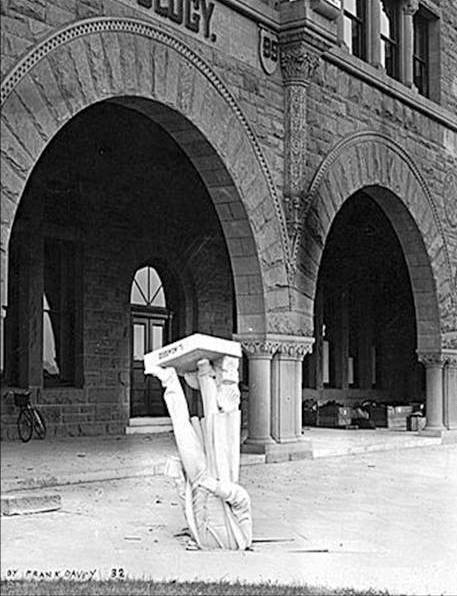
The War of the Worldviews

More often than not, the controversy between catastrophism and uniformitarianism is represented as a conflict within the geological sciences. But considering that in catastrophism a dynamic picture is given of Earth history, and thus of the Earth, whereas uniformitarians try to play down as much as they think feasible the more global, rapid and life-threatening processes in favour of local, slow and innocuous ones (however preposterous the hypotheses they have to invent and defend), we must conclude that we are dealing with a conflict between two antagonistic, incompatible worldviews, vastly transcending the field of one particular discipline.

The fight has indeed been raging for thousands of years. Plato was a catastrophist, Aristoteles tried to play down what Plato considered to be historical discontinuities. Two millennia later, Leibniz sounds as Aristoteles redivivus.

After a wave of catastrophist theories during Romanticism, the uniformitarians proclaimed their view to be the only scientific one, and triumphantly declared the battle won. When during the 1970s the Chryse Flood was discovered on Mars, an oceanless planet, geology professors didn’t resign en masse and go back to school, but continued pontificating that such a flood was impossible on Earth. Doubts about uniformitarian dogma arose only in 1980, after the K-T discoveries, which caused however but a minor crack in the wall of Academe. The uniformitarians stood their ground and tried to encapsulate the new findings into their system. They turned up with ‘catastrophist uniformitarianism’ –  a contradictio in terminis, and worse, a metaphysical confidence trick: the appropriation of empirical findings by a magical formula. More cracks and holes appeared, but now, after 2005, they have to try corking up a really big one.

But as before, uniformitarianism will find its staunch defenders – not because they can produce arguments of any validity, but because they are well-conditioned:  Natura Non Facit Saltus.   The war of the worldviews may go on unabated for a long time to come.

This Manifesto

This Manifesto is not an attack but a counterblast. We, persons who have understood that we are born on a highly dynamic planet that tumbles and gyrates and spirals through a highly dynamic universe, have been calumniated, cold-shouldered, blacklisted, denied research funding, refused publication space, and chased out of jobs by sectarians who took power at the universities around 1860, sectarians as dogmatic and repressive as their christian predecessors, and who tried – and continue trying – to describe the world as static as they can. And to enforce consensus, they continue using ad-hominem arguments, their “common sense”, the anonymous peer-review censorship system, and the medieval Occam’s razor, long since rusted and blunt.

48 comments to Guest Blog: A Catastrophist Manifesto from Han Kloosterman

  • Bruno Benjamin Scialom

    Any professor straying from mainstream’s way of thinking is immediately tagged as narrow-minded. “Common sense” became a real dictatorship in the world of science (not to say all communication means), from kindergarten to university: a teacher who doesn’t share nowadays principles “as given” might be ridiculed by 13 years old students at high school. Serious researchers, in the quest of genuine understanding should be able to discern theory from proved facts to start with, and not to take theories automatically for granted. Unfortunately, “common sense” adapts reality to theories instead of doing the opposite, while politically correct unanimously assumed theories became the contemporary gates for obscurantism and embezzlement.

  • E.P. Grondine

    Never let data interfere with theory, particularly if your income depends on it.

  • admin

    Welcome, Bruno. Good to see you E.P. Thanks a lot for visiting and thanks even more for commenting. Didn’t you enjoy Bert’s manifesto? It is spot on.

    The uniformatarian paradigm is extraordinarily deep-seated and it deserves any and all criticism it receives.
    Wind and water and tectonics are indeed powerful forces — but by god, Mr Geologist, you better make sure that every force is accounted for, even things you have never considered (i.e. swarms of space borne atmospheric bombs a la tunguska). To the astronomers (even worse) get humble and work from a presumption of personal stupidity. You do not have the information or authority to overrule 13,000 years of “myth.” And if you are wrong in the slightest — you are dangerous in the extreme. That archeologist in my experience are a lot better because they more readily accept their ignorance.

    Keep posting and send me some material! E.P. How about sending me something from Man and Impact in the America’s? Your book is packed with blog worthy snippets!

  • The impression that I continue to have, is that unfortunately the bastions of uniformatarism remain deeply ensconced througout the scientific community. The belief that gradual processes, with but few exceptions, such as periodic localized events such as volcanic eruptions, earthquakes and some weather events, continue to overwhelmingly dominate the forces shaping our planet remain. There was a time after the time of Gottfried Wilhelm Leibniz in the early 1700′s, when a temporary movement towards viewing catastrophic events as also prominent was in evidence. This was in the 1820′s and 1830′s when scientists like Adolf Erman and Georges Cuvier expressed the view that a huge widespread devastating event took place at the close of the Last Ice Age, and was cause for the enigmatic deposits of ice age mammals deposited high above the valleyn floor throughout parts of Alaska and Siberia. The open mindedness displayed by these two (and a few others since), quickly dissipated just after the 1830′s with the writings of George Lyell and James Hutton. I believe that overall we contiune on in this unfortunate vein at present. The great quotation by paleontologist Dewey J. McLaren in the early 1970′s is still appropriate. Dr. McLaren stated ” following the overthrow of catastrophism, there has been a natural tendecy to overcompensate and to avoid catastrophism interpretations even when the evidence calls for one.”

  • Han Kloosterman

    Han Kloosterman answers:
    Thanks for the comments, Bruno, E.P. and Rod.
    Bruno:
    Once you’ve deconditioned yourself in one respect, that’s just one step, and the question arises what’s going to be the next one. Which of the sacred opinions I harbour are mere received ideas?
    It is good to be conscious of the fact that the division line betw. academic science and the “lunatic fringe” not only changes with time but also with place. Dowsing, elsewhere taboo, was in the Soviet Union and is now in Russia perfectly respectable in Academia. The Clube/Napier scenario, around which formed in the 1980s in the UK an interdisciplinary school to which p.e. adhered Sir Fred Hoyle, grand old man of astronomy, was met in the USA with an ear-deafening silence.
    E.P.:
    “Never let data interfere….”
    That sounds like a quote. Is it yours?
    I wasn’t aware of your book. I am especially interested in Amerindian myths, with more disaster traditions – Great Floods, Geat Fires – than in the eastern hemisphere.
    This morning I found that it is not present in a Dutch library, and that I cannot get it through the American bookshop here. Do you have a suggestion?
    Rod:
    “The openmindedness . . . quickly dissipated just after the 1830′s”.
    The ideas in geology correlate well with the general cultural movements, Enlightenment, Romanticism, Positivism-Materialism. During the 18th century, after Leibniz, Burnet and Whiston, catastrophism and uniformitarianism coexisted without a sharp line dividing the two camps. During Romanticism catastrophism prevailed, with uniformitarianism as an undercurrent, with antagonism but without discrimination.
    Then, around 1860, there was a materialist coup in Academia, applying over the whole political spectrum. And whereas there are direct lines from proto-nazi Ernst Haeckel to Hitler, and from Marx and Engels to Stalin, the moderate Left and Right took over Academia, with as their prophets the socialist Ludwig Büchner whose “Krafft und Stoff” became a runaway bestseller, and the liberal Auguste Comte whose slogan Ordem e Progresso can be seen even today in the Brazilian flag.
    Only after 1860 the division into academic consensus and “lunatic fringe” was created by the dogmatism of the academics, a dichotomy similar to the medieval one into orthodoxy and heresis.

  • Thank-you first to George Howard for what I think is a terrific forum> And I would like also to reinforce the views as expressed so very eloquently by Han Kloosterman. You are so correct, I think in your asssessment as stated above. I think a very good example of the deeply entrenched attitudes, indeed dogmatic in their intensity, have been eocountered by many including the likes (as Han also mentions0 of Drs. William Napier and Victor Clube as well as Sir Fred Hoyle. There is another scientist that I am sure you are aware of as well, and that was Dr. J. Harlan Bretz (1882-1991)(who it so happens I dedicated my book to). Dr Bretz was the first to identify the unusual landscape (the Channeled Scablands) of eastern Washington, as shaped by a megaflood way back in the 1920′s and 1930′s. Against all manner of derision he perservred in his views for about forty years before. Then it was finally recognized that he was correct. Many more scientists since have been subject to ridicule and more. And in closing, I think I would rather be included in the lunatic fringe (that perhaps has become to think) than the dyed in the wool unchanging scientists who may not even be thinking.

  • Han Kloosterman

    Rod,
    In the middle of so many sad stories the Harlan Bretz’ story is exceptional because it had a happy ending. When Bretz was rehabiliated he was 90 ys of age, and able to enjoy it.
    I include my own in the few happily ending stories. I made the correlation of the end-Alleröd Usselo Horizon with the Twocreekan in North America in 1977 (An Alleröd Conflagration? Catastrophist Geology 2/1: 13-15). After a quarter of a century appeared Rick Firestone and Allen West who got independently about the Clovis Layer the same ideas as I had about the Usselo Horizon – and they had, unlike me, lab equipment to analyse their samples. And I, old though not quite as old as Bretz, am able to enjoy it.
    The truth always wins? O no, I’m not at all sure about that.
    The paradox is that the message is not enjoyable at all: we were born on a life-threatening planet.

  • admin

    Han, can you send me a copy of?: An Alleröd Conflagration? Catastrophist Geology 2/1: 13-15. I want to post it.

    FYI, and BTW, I am also working on having recent comments like these directly accessible from the front page. Right now no one can click from the snippets currently visible to these discussions….

  • Han Kloosterman

    George, you can find it through the online Velikovsky Encyclopedia, which gives a line to my personal page.
    No, I’m not a Velikovskian – but you know that.
    You’re welcom to post it.
    Han.

  • Han Kloosterman

    George, the link is “The Fire Planet”.
    Han.

  • admin

    Where, Han? Can you cut and paster the link? I found a bunch of interesting stuff, as always on that site, but can find any the Kloosterman Papers.

    BTW, I will delete these talks a some point, to clean it up. Maybe.

  • E.P. Grondine

    “I am especially interested in Amerindian myths, with more disaster traditions – Great Floods, Geat Fires – than in the eastern hemisphere.”

    They are not entirely myths, Han and several of them were written
    (though we have trouble reading them).

    You can think of an oral corpus as a library – children’s section, religion, philosophy, how-to books, adventures, romances, histories. The histories were usually kept in the “reserve room”, held by specially selected and trained individuals.

    It is comforting to know that you are not a Velikovskian, as the man’s linguistics, physics and achaeology were terrible. As Leroy Ellenberger points out, he was a plagiarist as well.

    I suppose that you were startled by the data you found in the excavation, and that is what brought you into Velikovskian circles at that time, way back when.

    Thanks to Clube and Napier and many others, we now have well developed impact models, and the past is becoming less confusing.

  • E.P. Grondine

    Han, today’s “lunatic fringe” with its theosophist roots is a well developed industry, and they have their own beliefs, which deny and defy reason and data.

    I have my own short summary if you’d like to post it.

    I would like to see this forum focused tightly on asteroid and COMET impacts right now, and leave the retro-spective analysis for later on.

  • Han Kloosterman

    E,P.,let me specify that I am a NON-Velikovskian, not an ANTI-Velikovskian. I have never moved “in Velikovskian circles”, but I insist on keeping on friendly speaking- and e-mail terms with them.
    I think V. was an excellent bibliographical researcher, I have picked up some useful references in the 2 books I’ve read, and after I found, with much work, some references it has happened that I noticed that V. had found them decades before me, without the benefit of the Internet.
    The accusation of plagiarism is unfair. V. doen’t tell us how he got his references, but who does? That’s required nowhere, and not customary.
    Unfortunately V. was more of a scholar than of a scientist. I don’t like his planetary ballet, and before he pubished Earth in Upheaval he should have shown the MS to a geologist, to avoid silly mistakes. And I think the Dark Ages were indeed dark, that’s obviously (to me) a post-catastrophe darkness.
    I admire Harry Hess, at the time of the Velikovsky controversies the only honest academic geologist around.
    Han.

  • Han: Is the Dark Age you refer to in your posting the so called “European Dark Age” If so, a part of this time was the period of 535 AD to about 545 AD, a time when many believe that there was one of the cosmic encounters of which I speak of in my book, “Sudden Cold, An Examination of the Younger Dryas Cold Reversal” Rod

  • Han Kloosterman

    Rod,I was referring to the Dark Ages in Greece between Mycenaean/Minoan times and the classical period – the centuries Velikovsky tried to eliminate. Perhaps the gap was somewhat shorter than in the academic chronology?
    I have the impression that V. had a tendency to shorten timescales, whereas I have a tendency to lengthen them.
    In the academic progressive sequence from Palaeo- and Meso- to Neolithic, to Bronze and Iron Age, the ubiquitous Megalithic remains have no place.
    What if they are much older, “antediluvian”? Then we can hypothesize that the incredible Francocantabrian rock art, in a style utterly unexpected from hunter-gatherers, was made by an artists’ colony, comparable p.e. to the group of western artists on Bali, a century ago.
    I haven’t researched how the megalithic remains were dated, but I harbour a deep mistrust of the establishment scheme.
    Food for Atlantologists? Well, I’m not afraid of the uniformitarians, so why should I be of the Atlantologists.
    Han Kl.

  • Thank-you very much Han. A comment on Veilkovsky if I may. I read with great interest his book “Worlds in Collision.” Veilkovsky was certainly a free thinker. I believe he must be respected for that alone. However, do you believe he may have been correct about the planet Venus as being captured by the Sun, not from a comet form, but instead having an origin as one of the moons of Jupiter? I happened to read this idea somewhere or another just recently. Rod.

  • Han Kloosterman

    Rod, let’s not start a Velikovsky discussion here. My manifesto is directed against the uniformitarians.
    E.P., thanks for sending your book.
    Han.

  • George Howard

    This is largely a V-Free zone, though it is in suspension while an audience is being built.

  • E.P. Grondine

    Han –

    Let me start off by pointing you to Leroy Ellenberger’s discussion list on Velikovsky, and suggest to you that you discuss Velikovsky with him. He is the expert on him, and Velikovsky was a plagiarist.

    Moving on, megalithic sites are well dated; early faulty dates for them are only promoted by those I have named “cult archaeologists”, and they have developed quite a business promoting bad archaeology, their peculiar “theosophist” religious beliefs, and fascist political theory, as their religion promotes the concept of superior races (when it doesn’t promote the select intervention of aliens in human development).

    The beginning of megalithic tradition is seen in Turkey at Gobleki Tepe. These structures were built after the YD impacts, and the YD impacts may have been causative for their construction.

    They likely followed on earlier wood henge technologies.

    When and how these megalithic technologies spread, and how they further developed, is an interesting area of research, one beyond the scope of discussion on this comment form.

    That said, as an example of the power of impact in chronological work, the megalithic culture on Malta disappeared entirely in 2,360 BCE along with the population, the same year as the Rio Cuarto impacts, the date for which is now known from Mayan records.

    Any time you ignore the work of those archaeologists who have spent their lives trying to establish chronologies, you are not doing science, and one of the most powerful results of impact studies is that they allow better precision in chronological work.

    I believe that if Clube and Napier had had a better understanding of Egyptian chronological works, their books would have received a better reception.

    Comet and asteroid impacts are what differentiate catastophism from neo-catastrophism; give the limited resources, the focus should be on scientific impact studies, with retrospective analysis of earlier catastrophism left for those working on the history of science.

  • Han Kloosterman

    E.P. I don’t intend discussing V. with Leroy E., because he would start shouting. He and I have different opinions, and we have done our bit of shouting already. Let me stay on friendly e-mail terms with him.

    If you accuse V. of plagiarism you should give examples, and not hide behind Leroy’s back.

    I am interested in “cult archaeology” though I am not a theosophist and even less a fascist. I am possible more antifascist that you are, because I have personal experience of it.

    “(T)he intervention of aliens in human development” has not only been popularised by “the hotelier von Däniken” but also by Robert Temple in his well-researched book The Sirius Mystery. What’s the connection with catastrophism?

    The “archaeologists … who have spent their lives trying to establish chronologies” were and are uniformitarians, followers of the Marxist Gordon Childe (“What Happened in History”) who has spent 10.000 years in an Earth-orbiting satellite with electronic monitoring equipment aboard, writing up what he heard and saw beneath him.
    Western Marxist were often more dogmatic than Soviet ones.

    “the focus should be on scientific impact studies.”
    Now you are giving rules, and I for one don’t intend to follow them. If you want to focus your research, by all means do so and send me a copy.
    I am interested in a general way in discontinuities in Earth history, by whatever agency they were caused.

    Cheers,

    Han.

  • E.P. I must take exception to those you call “cult archeologists.” There are a number of excellent archeologists, such as Dr. Tom Dillehay and Christopher Hardacker, both who have done extremely diligent work in the Americas to do with the dating of very early peoples.Their work has found that the Americas have had people here much earlier than the very conservative, dare I say dogmatic, scientists contend. For the longest time,and I am sure it continues to this day, Dillehay and Hardacker have not been given the time of day by most other archeologists.Let’s be fair, and at least admit there is a healthy debate that must go on here. The ignoring of the early dates reminds me what has gone on for years in regard to the Clube and Napier findings. Once again, this scenario is being played out all over again with oppostion to the comet hypothesis as cause for the Younger Dryas.

  • Han Kloosterman

    Rod, I’ve seen the reviews of Christopher Hardaker’s book on Amazon.com. I’m going to order his book.
    Han.

  • Hi Han: Yes it is a very good book I think. Though if you read between the lines I think you will see he is a little angry and also frustrated by the mainstream science (understandably so I think).

  • E.P. Grondine

    Rod –

    The issue of early dates for the first peoples in the Americas is entirely separate from cult archaeology.

    “Pole shifts” and absymally bad dating, physics, and archaeology lie at the heart of cult archaeology.

    Asteroid and comet impact studies stand in opposition to cult archaeology, as cult archaeologists make their money promoting “mysteries”, while impact studies end those “mysteries” in a most sudden manner.

    Other natural phenomenon are perfectly acceptable data.

    Leroy knows Velikovsky far better than I do, or ever will. I will just repeat his demonstrated conclusion that Velikovsky was a plagiarist. Comyns Beaumont.

  • E.P. Grondine

    PS – you can email me for a detailed history of today’s cult archaeology industry.

  • George Howard

    I like V. V is cool. But V is not good for The Tusk and you guys are are fighting the last war. Contribute new information and links — do not analyze the recent past of studying the recent past.

    PS. I will do a V blog soon enough and we can have a good run there.

  • George Howard

    Rod, book in hand. Reading now when I get my glasses and my wife lets me before before bed.

  • George Howard

    E.P. — thanks for pumping The Tusk around the net. Nice hits today from the DG. A favorite of mine as well.

  • George Howard

    Han, relax and breath deeply. These guys do not know you have a tube in your throat. Don’t let them get you riled up about Velikovsky. I personally would like to hear about your encounters with Catastrophist geology in your travels around the world.

  • Han Kloosterman

    George, I have made it clear to E.P. that I have opinions of my own, and that nobody should try to bully me into an exclusive impact paradigm. And then he just repeats what he has said in his previous message, making it worse with errors of concordance (“phenomenon are”)and of philosophy (“natural” which has a different meaning in different paradigms). This is sterile, a yes!no!yes!no!
    debate.
    V. was erudite and polyglot, and his English, perhaps his 4th or 5th language, was as good as, say, Leroy E.’s – bien étonnés de se trouver ensemble.
    My own (minor) doubts about academic procedures began when I was a student and the professor of geology at Montpellier U. “proved” that I was wrong about a sediment in which I had found foraminifera. He took a tiny sample and washed it as rapidly as he could. That’s the method Rick Firestone is running up against now as used by the adversaries of the-Clovis/Usselo-Horizon-as-an-extinction-layer.
    Researcher bias.
    Han.

  • I must pass along my apology to you Dr. Grodine. I misuderstood you. I thought you were lumping the likes of Dr. Tom Dillehay and Christopher Hardacker with the fringe element (I aggree there is some) out there. I would love to see something here at the Cosmic Tusk on Dr. Tom Dillehay’s work in South America. Though not directly related to the subject of cosmic impacts, there may be some evidence of times when early people had to abandon their settlements because of very dire conditions, (possibly caused by cosmic impacts).

  • Han Kloosterman

    Rod, Dillehay’s work certainly has something to do with the Alleröd/Younger Dryas boundary. The Usselo/Clovis Horizon was found in Colombia (Van der Hammen Th, Hooghiemstra H, 1995: The El Abra Stadial, a Younger Dryas Equivalent in Colombia .Quatern.Sc.Rev.s 14/9: 841-851), and in Venezuela (see ref.on Cosmic Tusk).
    And in the profiles Dillehay gives of Chile there is also a dark horizon on the to-be-expected stratigraphical level.
    Han.

  • George Howard

    Linked your paper, Han. Thats cool I can do that.

  • Han: That is exciting re: an anaomolous layer at the beginning of the Younger Dryas. Any thoughts why the layer would be dark? Is it somewhat like the black mat seen further north? I examined some papers from South America (coastal area) and found some interesting features re early settlements in that region. There was an early fishing village inundated, not once but a number of times. (four). The first of those just happened to be close, or perhaps even coincided with the beginning of the YD. Now the explanation given by the scientstis doing the study was that torrential rsins caused massive mudslides. The times when this region does receive copius rainfall (as it most often dry) is during El Nino events. The problem with that idea is that the El Nino phenomena did not begin, according to Australian proxy till about 5,000 BP. Intrigung to say the least? I did suggest somewhat bravely (hope not foolishly)in my book that a megatsunami possibly linked to a extraterrestrial impact may well have been the cause. Of course very large localized earthquakes, especially those associated with subduction plates (in that region) may also be an explanation. Dr Ted Bryant may be the best person to ask about this? In any case, with more information from South America, perhaps the cause (assuming it was triggered mudslide by either tectonic or extraterrestrial influences) might be revealed.

  • Han Kloosterman

    Rod, the “black mat” of the Clovis Layer was as a term and as a hypothesis introduced by Vance Haynes Jr. in his younger days, when he committed a lot of sins, such as being a proponent of the Clovis-first dogma. But he became a wonderful illustration of the saying that one’s never too old to learn.
    In the “black algal mat” no algues were found, and until the day there are, I don’t believe in the hypothesis.
    What me struck in 2002 when I visited Murray Springs, Arizona, and later when I saw pictures of the layer taken at other N.Amer. sites, was the similarity with the European occurrencies.
    Together with the occurrencies in S.Amer. (Colombia, Venezuela and probably Chile) and in Africa (Egypt and S.Afr.)
    enough to conjecture a world-wide layer.
    My own survey, from the UK to Poland and Belarus, from Denmark to France and Italy, stops at the Russian border, I think only because I don’t read Russian.
    O yes, and there are a few more sites East of the Mediterranean found by Marie-Agnès Courty, which I have to look up.
    Han.

  • Han: Yes, this is all very exciting material to be sure. The very recent geen layer found by Melissa Scruggs (to be reported in full soon) is also very intriguing. I think too, that if more conclusive evidence could be found along ocean perimeters (boulders etc) much like Dr. Ted Bryant has found and reported in his fine book “Tsunami The Underrated Hazard” (primarily from Australia), the case for cosmic encounters would be strenghtened even more.
    George; Glad you made a start on my book, hope it didn’t cause you to drift off to sleep right at bedtime.

  • Han Kloosterman

    Rod, for mega-tsunamis see Luigi Piccardi and Bruce Masse.
    Han.

  • Han: Thank-you, I will check these two out.

  • It should be noted that at locations where you find the ‘black mat’, the sedimentary material covering it usually doesn’t represent a significant amount of erosion, or mass movement. That means that many, if not most, of the surfaces which could be considered as co-effected materials of the same atmospheric conditions that the Nano-diamonds formed in, whether just burned, or kicked around a bit, are still in perfectly pristine condition. It also means that a single chronological horizon can be established for almost all of western North America. And that chronology bares no resemblance to the mutual inter assumptive confabulations of uniformitarian theory.

    I’m not sure the world is ready for just how far reaching the upcoming paradigm shift is going to be. But we’re in it. There’s no turning back. And the realization that the world isn’t flat, is pretty ho hum by comparison. Between Firestone, and friends, and Bill Napier, Chuck Lyell must be rolling in his grave.

    The part that I don’t hear sinking yet in is that with Bill Napier’s latest paper specifically proposing in refereed literature that the Taurid Progenitor was the Younger Dryas comet, he changed the game completely. Because he didn’t just give us a convincing astronomical model of the event. We also have a pretty good picture of the physical properties of the thing that did the disastrous deed. And if you can describe a beast, you can predict it’s footprints.

    With Bill Napier joining the fray, YD impact hypothesis has become a fully fledged theory that can successfully predict the planetary scarring. And it isn’t craters.

    What say we take a great big comet, say 50 to 100 km wide, out of the Oort Cloud, or the Kuiper belt, and inject it into the inner solar system. And we park it an elliptical, Earth crossing orbit, and break it up into not so little pieces. Let it make a couple of orbits, and so that tidal forces can break it up completely, and stretch it out into a very long stream of particles, and fragments. Our average fragment size is about the size of the Tunguska object. But they range all the way from more than a half mile wide, down to clouds or dust.

    We’ll bring it in from the south at a low angle. And about 30 km/sec. The first fragments to hit will produce temps well over 100,000 degrees C. And they are just cheerleaders, twirling batons in front of a parade. The rest fall into already superheated impact plasma, and just crank up the heat, and pressure. In this way, almost 100% of the kinetic energy gets translated to heat, and pressure. And that heat, and pressure, hit’s the ground as an almost continuous supersonic stream of completely ionized, thermal impact plasma, hotter than the surface sun.

    In just a few minutes, I bet we could sterilize the lush, African Savanna, and make it look just like central Mexico , and the American Southwest.

  • George Howard

    Nice summary, Dennis. Keep it up!

  • Dennis Cox blog, plain text, with images of samples of magnetic black glaze on melt rocks from 13 Ka ice comet fragment extreme plasma storm geoablation in Fresno, California: Rich Murray 2010.07.02
    http://rmforall.blogspot.com/2010_07_01_archive.htm
    Friday, July 2, 2010
    [ at end of each long page, click on Older Posts ]
    http://groups.yahoo.com/group/astrodeep/message/53

    Since November, 2008, I’ve found many sites within 160 km of Santa Fe, New Mexico with similar features, including red-brown sandstone, white-pink granite, lava, and other surface bedrocks, popular as 1 m size parking lot decorations, with ubiquitous black and redbrown surface glazes up to 1 cm thickness, as well as many rocks with white surface coatings.

    Common are rounded, often broken, quartz rocks from 2 to 25 cm size with softened and melted surface layers, often with a light yellow color — I imagine quartz rocks suddenly heated and cooled, like glass, will store internal stresses from thermal contraction that cause them to easily and even explosively fragment — a hazard well known to glassblowers.

    Sun Mountain
    35.659284 -105.912294 2.421 km el, about .191 km rise,
    S of St. John’s College, parking lot 2.230 km el

    Sun Mountain just SE of St. John’s College, on its NW slope, below the summit, has many intersecting cracks in the white-pink granite bedrock, about 10 cm thick, about 1 m apart, filled with irregularly crystalized quartz — I imagine that the extreme pressure plasma impact may have opened cracks that were filled the next moment by melted quartz — there are many smaller rocks with similar filled cracks of various colors.

    Two Mile Reservoir
    35.689440 -105.894726 2 miles E of Plaza, E of end of Cerro Gordo Road against Upper Canyon Road, the Santa Fe River, a 0.13 km long pond left over from a drained reservoir for hydroelectric power.

    The top to the N is 2.259 km el, 21 m above the pond’s 2.238 km elevation.
    The steep rise to the NW of the pond has a good walking path along a 1 m high aluminum wall, giving easy access to many kinds of blasted, broken and glazed rocks in this public park.

    http://craterhunter.wordpress.com/the-planetary-scaring-of-the-younger-dryas-impact-event/california-melt/
    [ many fine color photos on this article -- this plain text copy has been mildly edited, nothing taken out, to fix minor typos and add spacing to increase readability ]… more

  • Full screen view of Rogelio D Acevedo at top rim edge of large crater, Bajada del Diablo, Argentina: National Geographic Blogwild, Ami Bucci 2009.09.11: Rich Murray 2010.03.28
    http://blogs.nationalgeographic.com/blogs/blogwild/2009/09/mega-meteorite-mystery.html

    [ you may have to copy and paste these URLs into your
    browser, or just highlight and then click on the URLs, as
    this is a plain text document ]

    http://blogs.nationalgeographic.com/blogs/blogwild/2009/09/mega-meteorite-mystery.html

    3 images — within the blog article, right click each photo to Save, or select, Open in a new window, to access larger
    views, which can also be right clicked to Save

    two men, dark green and dark red pants, by far edge of flat
    center of crater, with broken dark rocks, up to 2 m size,
    with higher crater rim of lighter rocks
    608 x 456 – 139k – jpg

    full screen view of Rogelio Acevedo [ dark green pants ]
    at top rim edge of large crater, with dark flat center behind
    and below him, then the less high opposite crater rim of
    lighter color rock, curving around behind him on the right side of the view, with view across plain to far mountains [ south ? ]
    – at his feet the rocks are about .3 to 2 m size and “volcanic”, blue-black mixed with red

    very large full screen view of man with red pants with metal
    detector at edge of flat crater center of dark gravel-like
    pebbles, this side of the crater rim with a variety of sizes and types of “volcanic” dark, red, grey, and white rocks, mixed jagged and rounded

    September 11, 2009 4:22 PM
    Megameteorite Mystery
    Posted by Amy Bucci — Blogwild Contributor

    National Geographic staffer Fabio Amador shared some news
    about one of our National Geographic Society/Waitt grantees,
    Rogelio Acevedo, a geologist from the Centro Austral de
    Investiggaciones Cientificas in Argentina. [ in green pants ].

    In a remote region of Patagonia, enormous craters measuring
    up to 500 meters wide and 50 meters in depth could be
    evidence to a bombardment of meteorites.
    This meteoroid impact field, the largest in the southern
    hemisphere, is of extreme interest for Dr. Acevedo.
    This site, call Bajada del Diablo or Devil’s Descent, contains more than one hundred impact craters spread over 400
    square kilometers.

    Curiously, no meteorites have ever been found, but Acevedo
    and his team will be traveling there this October in hopes to
    solve the mystery by studying petrographic and mineralogic
    marks on the rocks.

    ground views of over 100 .1-.5 km shallow (ice comet fragment bursts) craters, Bajada del Diablo, Argentina (.78-.13 Ma BP) [42.87 S 67.47 W] Rogelio D Acevedo et al, Geomorphology 2009 Sept: Rich Murray 2010.03.28
    http://rmforall.blogspot.com/2010_03_01_archive.htm
    Saturday, March 27, 2010
    http://groups.yahoo.com/group/astrodeep/message/47

  • Terry Egolf

    As a confirmed catastrophist, may I provide some helpful resources that may shed some light on various topics raised in this manifesto?

    The first addresses the crisis of understanding what the term ‘uniformitarianism’ actually means by those that subscribe to it:

    The second deals with the peer review issue:

    I chuckle at the way this group glibly discusses the reality of a 12.9 ka event in the same way that true uniformitarians speak of billions of years of earth’s history. And for the same reason: uncritical acceptance of radiometric data. Everything seems to work out fine as long as nothing unusual of a global extent affected the factors contributing to radiometric data (the essence of uniformity). But IF something like a relatively short, intense period of global volcanism occurred just 5500 years ago, that would throw off all (carbon-14) radiometric dates for organic materials much older than about 5000 years.

    Don’t get me wrong. I fully support the idea of cosmic impacts in recent times. The geologic evidence is all over the world in the form of 170+/- impact features, and these don’t include the evidences for comet detonations in the atmosphere. It is just that my time-frame is telescoped into a period less than half the age of what you guys are dealing with. And except for the occasional rogue comet, probably most impacts occurred within a few months or even weeks of each other during a meteor swarm that affected the entire solar system about 5500 years ago.

    I realize this post will just be shrugged off as the unwanted ramblings of a young-earth creationist (sorry George, but I couldn’t resist), but if you are truly interested in developing a coherent geological, biological, and anthropological model based on recent impacts, you might find that a catastrophic global Flood model may be very helpful.

    Terry Egolf
    Greenville, SC, USA

  • Terry Egolf

    I’m obviously not a html guy. Sorry about the links in the last post. Perhaps George can fix them, or delete the post in its entirety if he wishes.

    Terry

  • Rich, there may not be any meteorites there. There weren’t any at Tunguska. But airbursts should never the less produce a significant enrichment of siderophile elements Ni, Co, Cr, etc. And there is also the potential for extreme thermal effects, and burnt facies.

    While your on your road trip Ed, If you want see a few new craters, or airburst burns, these places might be worth a closer look.

    31.347399, -105.364137
    30.941671, -104.531153
    35.135053, -104.747908
    33.861993, -106.000411
    33.710195, -105.329311
    33.169739, -104.301552
    34.364134, -104.995863
    35.161413, -104.700073

  • Steve Garcia

    Hans,

    This comment of yours struck me as worthy of comment, more than all then others of yours and everyone else’s:

    —”Only after 1860 the division into academic consensus and “lunatic fringe” was created by the dogmatism of the academics, a dichotomy similar to the medieval one into orthodoxy and heresis.—

    Yes, by 1860, they had begun to think of themselves as the winners. Once they got the feel for being on top (they’d been underdogs to the Church for oh so many decades), the realization kicked in, and so did the hubris – “Hey! We get to lay down the dogma now!”

    So, academia bequeathed itself pews, complete with kneeling rails, and the cloistering began in full force.

    As to this one in your post,
    “This schism pitted against each other, sometimes violently, academic geology (and biology, archaeology, history, mythology) and the so-called lunatic fringe, marginalised by the uniformitarian establishment – Atlantologists, pole-shifters, Velikovskians, Theosophists, etc.”

    Yes, the idea of “We are the bishops now,” took over. And just like the christians did in AD 325 at Nicea, anything disagreeable was simply declared “loony bin” heresy. That way they didn’t even have to reply to them. One of sciences most ridiculous efforts is when a scientist actually DOES address something contradictory. Without reading or investigating the phenomena, concept or evidence, a complete conjectural speculation is blurted out ad hoc, with a smirk, after which the “scientist” turns on his heel and walks out, considering the matter dispensed with.

    I’ve advocated that the Atlantologists and Velikovskians – and especially poleshifters – simply ignore the academics and start their own peer review, evolving their own standards. They have their own publications already, most of which have 5 times the circulation of any of the academic ones. The only danger in peer review is what you refer to as “censorship.” One would hope that that would not become major for many decades – but better our reviewers than theirs.

    But on that note, you point out 1700 as a demarcation. It was only a few handfuls of years before that that the Royal Society conclaved. Perhaps that also had something to do with the energy of Leibniz’ homogenization. I am certain he was aware of it and was influenced by its ethos.

    On that note, the Royal Society WAS behind my thinking about the lunatic fringe simply flipping the bird to the dogmatists of our day, like the Royal Society did to the Church.

    So maybe it is just as well that everyone ignored my suggestion. Otherwise someone 300 years from now will be writing about how silly all the dogmatic catastrophists are, in their Medici and Maori gowns at baccalaureate events – after all, it will have been 150 years since the last major impact; all that End of the World stuff is getting rather Noachite.

  • Han Kloosterman

    Hello Steve,
    On the 1860 cultural reversal I find amazingly little literature, perhaps because those who took power then at the universities are still in charge. I compare it to reversals in politics, the bad ones. The French Revolution became the Terreur, Marxism became Stalinism. Freedom fighters tend to become tyrants when in power.
    A good term for it I only found in French, in the novel Le Roi des Aulnes by the philosopher-writer Michel Tournier, who used it mostly for changes in the lives of persons. He called it Inversion Maligne. It is not a regression or a decadence or a downfall, but the blooming of a promising-looking budd into a big stinking flower. An ethical downfall, yes, – the participants loose their moral integrity.
    That is what happened in 1860, the empiricists of the Romantic era lost out against the rationalists (positivist à la Auguste Comte, materialists à la Leopold Büchner), who fenced in the field in which we were allowed to do research.

    Better not institute an “own peer review” system! Unless it is done with open visor, not anonymous like the hooded judges of the Holy Inquisition.
    And for the periodicals there should be a Freedom of Information Act, with free enquiry into the archieves, for the benefit of future historians of science. At the moment, a reviewer can tear apart a MS just because he/she dislikes the author. That’s not theoretical, it has happened to me twice, once in a Brazilian and once in a US scientific periodical.

    Gr.,

    Han.

    The 1700 demarcation – I’d say the last decade of the 17th century, with a great geological activity, but we had to wait another century for stratigraphic superposition to become firmly established by William Smith.
    Descriptions of the Earth before that, whether by Leibniz or by Kirchner, are hardly understandable to us.

    We don’t have to wait 300 years for dogmatic catastrophists. At least dogmatic impactists are here already, whereas there are other hypotheses around, launched by LaViolette, Topping, Warlow, Flodmark.

Leave a Reply


You can use these HTML tags

<a href="" title=""> <abbr title=""> <acronym title=""> <b> <blockquote cite=""> <cite> <code> <del datetime=""> <em> <i> <q cite=""> <strike> <strong>