


“The [Younger Dryas Boundary] theory has reached zombie status,” said Professor Andrew Scott from the Department of Earth Sciences at Royal Holloway. “Whenever we are able to show flaws and think it is dead [!], it reappears with new, equally unsatisfactory, arguments.
- “Sniff,” January 30, 2013, Royal Holloway Press Release two weeks before the Harvard discovery.

Among other causes, the Younger Dryas impact hypothesis [4] is based on observations and is testable. A C-rich layer, exposed in many sites in North America and Europe at or near the YD boundary, is enriched in magnetic grains with Ir, magnetic microspherules, charcoal, soot, carbon spherules, glass-like carbon withnanodiamonds, and fullerenes with extraterrestrial. This has been interpreted as evidence for an impact or aerial blast at ~12,900 years ago. Subsequent studies both cast doubt on [5-12] and found new support for [13-14] the petrographic evidence. However, the invoked markers have never been supported by a geochemical impact signature such as a sharp increase in Ir or other PGE concentrations……..
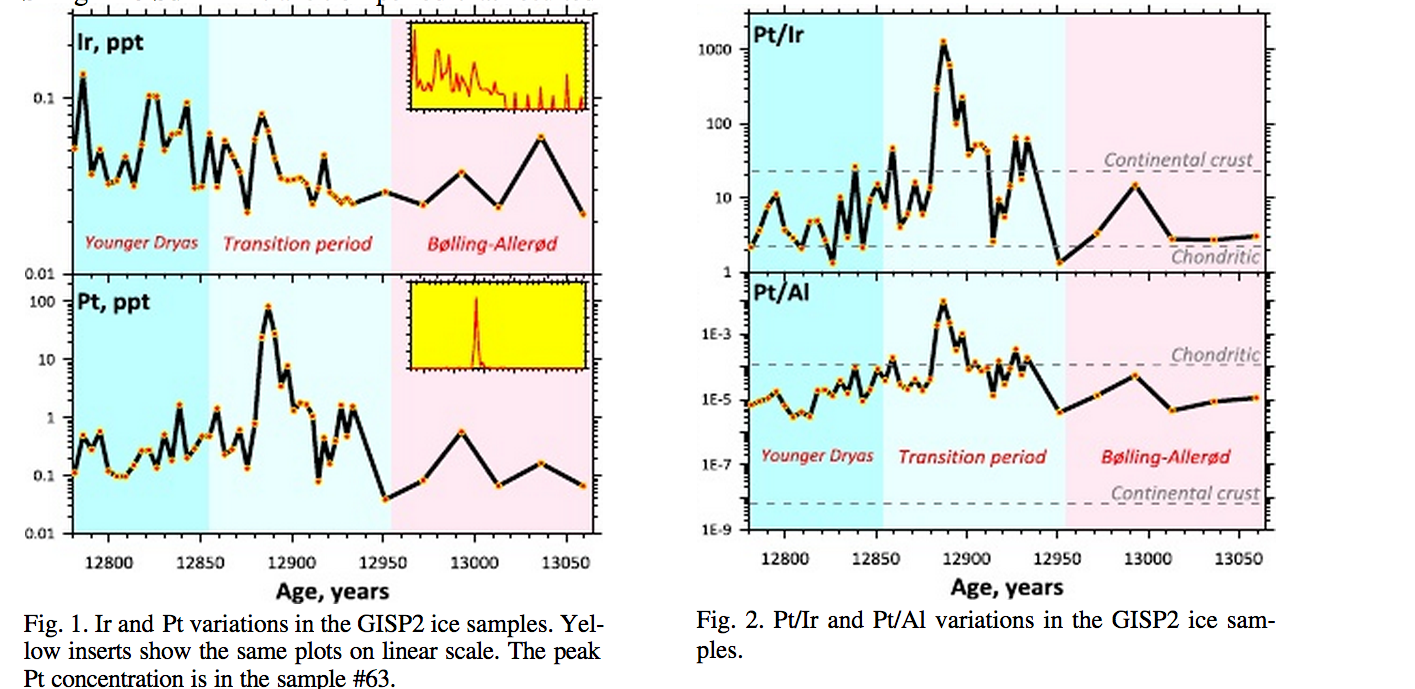
……..Our results could be explained by the impact of an iron meteorite with low Ir and high Pt con-centrations like Sikhote-Alin (IIAB) or Grant (IIIAB); the former is a large crater-forming meteorite shower. If the Pt peak is caused by an iron meteorite impact, then the observed gradual ingrowth of the Pt concentration in ice over ~25 years requires lifting impactor’s material above the stratosphere and formation of a ring around the Earth. The decay of the Pt signal is consistent with ~5-years lifetime of the dust in the stratosphere. Such an impact could result in a global Pt anomaly. An anomalous 50 cm thick ice layer with 100 ppt Pt would require a sub-km-size iron meteorite to account for the Pt mass-balance.Concluding remark: The main conclusion of our study is the detection of an unusual event during the Bølling-Allerød- YD transition period that resulted in deposition of a large amount of Pt to the Greenland ice.The nature of the event remains uncertain, but our results clearly rule out an impact or airburst of a chondritic bolide. If an impact was involved, the impactor had a very unusual composition deriving froma highly fractionated portion of a proto-planetary core.
Harvard Researchers Discover Evidence for Major ET Impact at Younger Dryas Boundary by George Howard

Loading...


This does seem contradictory to the evidence of Firestone et al who found an increased iridium signal in stratigraphy attributed to the the YD boundary, given that the hypothesised bolide in this study is low in iridium. It seems strange that there should be a high deposition of iridium over land and little accumulation of it in ice cores if the bolide was iridium rich, and even stranger if it was iridium poor.
Jonny,
metal condensation cores of comets, my lay insight, are needed for slow gravitational accumulation of ices and dust. If so, variant, inhomogeneous densities likely, especially if distinct pre-cometary parts combined, & would explain pt in Greenland, ir over land.
Why do you say “hypothesised bolide in this study is low in iridium” if it was most likely a comet or comet frag?
The following passage struck me as interesting:
1. A “huge” meteor shower – What does this mean, in general? Does it mean that the impactors were huge? That there were very many of them? Evidently those that impacted are the basis of this adjective, “huge,” since ones that didn’t impact would have left no trace.
2. That it was at ~10,000 years ago – Why do people confuse 10,000 years ago with 12,900 years ago, like they were two week apart? 2,900 years is essentially 50% longer than the time since J.C. That is a lot of “wow” (fudge) in their numbers.
3. If it was at the time of the YDB, it shows that at that same time there was a multiple impact, of some sort.
4. Halley and Hale-Bopp – didn’t they show that comets are not just ‘dirty iceballs’? As I understand it (please correct me if I am wrong about this), the distinction between comets and meteors/asteroids has become muddied (no pun intended). It seems that we are a long way from knowing what mixtures of ice and rock and iron are out there. If so, the West York “iron” meteor shower could have been a broken up comet with at least some iron and some other materials.
5. Are impactors assumed to be heterogeneous? If a meteor had broken up and was not heterogeneous, the fracturing could easily have been between the different materials aggregated together. (I assume aggregated because they historically seem to me to have been somewhat friable.) What better place to fracture than at the discontinuities?
6. If not heterogeneous, different fragments may have considerably different constituents.
7. On another front, some of us have concluded that the YD impact was a multiple air burst. A multiple air burst is different from a meteor shower in what ways? In materials, certainly. In any other ways? Yes – a comet break-up is more likely than a meteor break-up to be friable enough to air burst. If meteors can break up, and if the comet S-L/9 broke up, then obviously both meteors and comets DO break up.
Is there anything that prevents some of the fragments of a break-up from impacting while other parts air burst? That we have not yet seen it – is that enough reason to argue that it doesn’t happen? If ti happens once in 20kya or 30 kya, we would only get one shot at seeing it happen (if that). And if we try to recognize it having happened 10kya or 13kya or 20kya, what would we expect to see?
From all that off-the-cuff reasoning, it seems the West York iron meteor shower may or may not be connected with the YD, both in time and in its break-up. While doubtful in time, and even more doubtful in constituents, are we comfortable saying it is impossible?
I hate arguing from negatives, which cannot be proven or falsified. But I would lean toward putting this aspect of this paper in the back of my mind. More evidence may come down the line. Till then, I will say it is doubtful but that certain aspects suggest that knowing about it may prove useful later on.
Hermann -
In your first part, it seems we picked up on the same (in)homogeneous thing.
But I got my words backward! Dammit!
5 and 6 should read:
5. Are impactors assumed to be homogeneous? If a meteor had broken up and was not homogeneous, the fracturing could easily have been between the different materials aggregated together. (I assume aggregated because they historically seem to me to have been somewhat friable.) What better place to fracture than at the discontinuities?
6. If not homogeneous, different fragments may have considerably different constituents.”
I don’t know where my brain was with that word. Sorry, folks.
But it is also not impossible that it was pt in Greenland, ir over land, and part missed. The Earth, unlike Jupiter, may not have enough of a gravity well to ensure that all fragments would impact.
Addressing Jonny’s (and the paper’s) point:
“It seems strange that there should be a high deposition of iridium over land and little accumulation of it in ice cores if the bolide was iridium rich, and even stranger if it was iridium poor.”
I agree in principle. It does seem strange.
1. The evidence IS there that the meteor shower was Ir rich, and at about the same time, the ice cores show extremely Ir poor..
So, what kind of scenario can possibly explain that incongruity?
A. They happened at different times. 10 kya is not 12.9 kya.
B. They happened at the same time, but the fragments were different in materials. This could be possible (even if it would certainly be “strange”), based somewhat on my #7 above.
The more likely of these is A. But admitting that two very large impactors arrived within 2.9 kya of each other, or maybe even simultaneously – either one would be a problem for those who adhere to the “rare impact” viewpoint.
It seems that, one way or another, some viewpoints need to adjust/flex.
Hi Steve, kiddo,
don’t worry about that!
Q1 = Heterogeneous?
Q2 = Homogeneous?
Those two Q’s are logically equivalent,
A1 = not A2.
So, why do you think Jonny thinks it was low on ir? Is that in one of the papers by the Firestone team?
BTW, GUS* synched our brains, what? Even I first chose heterogeneous, then took homogeneous because people would know it better, can you believe that?
– - –
(*) Great Universe Spirit
Oh, come on, Jonny. Colonel Mustard with the Flat Iron, Colonel Mustard with the Chopping Block…..there is a bloody body.
What we have here are nervous servants walking around the corpse telling us the old man just tipped over with his toddy. Give me a break.
Steve, in regards to your question concerning bolide breakups, your question is incomplete.
If we are going to draw a line to distinguish between asteroids, and comets, then that line should be related to the amount of volatiles in the object. Or more simply: Is it an icy body or not? So if it’s a fairly solid chunk with no ices, or volatiles to out-gas in the inner solar system, it’s no comet. This brings us to recognizing that there may be many different breakup mechanisms to take into account, depending on the compositional nature of the object, and it’s structural integrity.
For example, the breakup of comet Shoemaker Levy was caused by tidal forces from Jupiter’s intense gravity field as it made it’s first close pass of the gas giant before returning to impact. There the breakup mechanism stretched the fragments out into a long stream that came back to impact one right after the other. But we don’t have to look very hard to find a completely different, and probably far more common breakup mechanism of an icy body.
Just take a look at Comets Linear, or SW-3. In both cases we see comets that broke up without any gravitational influence from a planetary body. It’s as if the ices holding them together lost integrity after sublimating away in the inner solar system, and they just came unglued like the wings of Icarus.
Bottom line: The breakup of an icy body can happen at any time. It doesn’t have to plow into an atmosphere first. Nor does it need to make a close pass of a planet, and be torn apart by tidal forces and stretched out into a string.
There is no logical reason to assume that a meteor shower, or large impact storm, is never the result of a large cloud of cometery fragments such as either of those two examples impacting soon after the complete breakup of a large comet. Yet the only pre-impact breakup mechanism folks seem to be able to consider is the silly idea that we only need to be concerned with single lone bolides that arrive one at a time, and don’t begin to breakup until they get here.
Herman,
It doesnt matter whether the iridium was in a differentiated core, or homogeneously mixed through-out the body upon impacting and vaporising, the debris becomes mixed in the atmosphere, and so will be deposited upon the ice caps, so if there was an iridium rich part that fell over the continent, then we should still see enhanced iridium in the ice cores. Indeed, if the scenario suggested is correct, and a ring of debris was formed around the earth, and coupled with a mean atmospheric residency time of 5 years, then we should expect an iridium excess in the ice cores if there was increased iridium on any part of the impactor. So in an extreme case, even if the bolide was made up of two halves, one iridium rich, and one platinum rich, with the iridium impacting over land and platinum elsewhere, we would still expect iridium enrichment in the ice cores.
The ice core chemistry does not tell us that an impact occurred over Greenland, merely that there was an impact somewhere.
I also say hypothesised bolide, since that is what it is, a hypothesised impact event of an platinum rich iron meteorite, since we have no conclusive proof that it was an iron rich impactor, or indeed if it is an impact at all. We have data that could be interpreted as an impact, and the authors have hypothesised it was due to a particular composition of impactor. They also note another hypothesis that the platinum could be induced by a super-volcano. Thus having two hypothesis we can now look for other physical evidence to support or falsify either hypothesis.
Steve,
It was noted that while the cape york meteorites could be dated to 10,000 years ago, there was equal platinum to iridium in them, which does not match the Pt/ir ratio in the ice cores, suggesting that they are different bodies, and likely not contemporary with each other.
Why this is considered a huge meteor shower is because of the large fragments of meteorites that have been found, the largest being 31 tonnes.
Undoubtedly the Cape York shower occurred at a different time to the YD boundary. Its inclusion in the paper would have been to discount a local contamination of the ice cores from this shower, since although the ice-cores can be dated with a degree of precision, such precision may be lacking in the dating of the Cape York meteors, thus some could potentially argue that the Pt anomaly was caused by the cape York meteor. By comparing the Pt/Ir content of these meteorites to the Pt/ir ratio in the ice core discounts this meteorite being the cause of the platinum anomaly.
Hermann,
I say that it was low in iridium because that’s what the ice-core data shows. If you look at the graph in figure 1b of the paper under discussion, you can see that there is no iridium anomaly associated with the platinum anomaly. Indeed, the iridium concentration at teh platinum anomaly is pretty much equivalent to background across the 300 years investigated. Therefore, as the authors conclude, if it was an impact event, then it would have to be low in iridium not to leave an iridium signal. Compare this to the 2007 Firestone et al paper in which they show in their stratigraphy analysis a marked excess of iridium at the YD boundary.
George,
No one is dancing around any body here, and all this paper does is confuse the identification of any body, as well as whether it was murdered or not. Indeed it goes so far as supplying a second dead body.
You posted a paper that on the surface seemingly supports Firestone et al, but when you look at the actual “forensic” evidence there is a glaring disparity in iridium concentrations between the two studies. Why does Firestone et al find an iridium anomaly at the YD boundary, but seemingly contemporaneous ice cores do not show such an anomaly?
The problem is this. Looking at the Harvard study alone, we can interpret this as an impact event. Looking at the Firestone data, it could be interpreted as an impact event. But looking at them together with the ice core chemistry, they cannot be both the same event due to the iridium evidence. Indeed, even if the Harvard data is not extraterrestrial in origin, it still leaves the problem of a lack of corroboration of enhanced iridium in the ice cores that purportedly date the same epoch as Firestone et al’s stratigraphy.
Therefore this paper is no help in reinforcing the YD impact hypothesis, and could in fact weaken it. Also, the Harvard study does resort to a form of special pleading. In order to explain the platinum excess, they propose an impact event, but in order to explain it as an impactor they must suggest that it is a special type of impactor from a fractionated proto-planetary core to explain lack of iridium. It doesnt mean that it is wrong, but it is a stretch.
Dennis,
There are different causes of comet fragmentation. These are, impact fragmentation, tidal disruption, thermal stresses, and spin up. The first three are self explanitory, the first occuring from an object hitting the comet with enough force to disrupt it. The second we observed with SL-9, and the third is the what we all assume is happening, but all three can give rise to the forth fragmentation mechanism.
As a rotating comet looses mass though jetting and gas drag on dust particles, it’s spin rate will increase. The spin rate increases in order to conserve its angular momentum. As the angular velocity increases, so to does the centrifugal acceleration until the weak internal forces can no longer balance the centrifugal acceleration, at which point the comet comes apart.
Thanks Jonny,
That’s exactly my point. And if we read Professor Napier’s Paleolithic extinctions, and the Taurid Complex describing the progressive breakup of a very large body then finding evidince of multiple major impacts over a period of centuries is to be expected.
I would be surprise if there was only evidence of one.
[...] the marvelous platinum result, I’m baffled! An iron meteorite is unlikely to fragment Earth-wide, and the lechatelierite [...]
[...] high Fe/Ni ratios, pdf’s, shock melted quartz, high 10 Be/9 Be ratios and occasional presence of platinum metals. Controversy over the impact, the so-called Black Mat enigma, and its relation to the Younger Dryas [...]
With all of the discussion about the possibility of multiple relatively current impacts I am a bit disappointed that more effort hasn’t been made with regard to identifying where these impacts may have occurred. I would also suggest that there have been numerous research expeditions around the globe that would facilitate the start of this study. For example ocean sediment depths.
I think it would be safe to assume that the odds are in favor of the majority of impacts striking in the oceans of the world and that where ever this has occurred all of the sediment in the strike zone would be blown away.
In my brief efforts to correlate this kind of research (there are volumes of sediment studies at Scripts Institute in San Diego) along these lines I found that one of the places where there is the least amount of ocean sediment is off of the west coast of South America. I believe there is also a substantial amount of other evidence that would suggest that a comet impact occurred there around 500 BC. (For instance: Darwin noted recent coastal uplifts in his studies in South America, recent digs on the Peruvian coast that date to this time where complete cities were buried under 50 feet of sediment)
I am sure that most of you are aware of the Yucatan impact (Chicxulub crater) which was discovered by a geologist working for one of the oil companies who was looking at gravitational anomalies. This kind of research (by oil companies) has also been conducted all over the world and as such could be requested – in regards to where likely impact zones could be located.
One thing that is missing though is an ACCURATE computer model for what actually would happen if a larger comet or asteroid hit the planet in the ocean. Although there are several out there, what is not included is how the crust would flex in such situations. In most cases it seems to be assumed that a comet would penetrate the crust in the same way that an solid object would. I would suggest that this is not the case. Of course this would be influenced greatly by the angle of impact as well. This could make for an interesting discussion:)
I believe there is some evidence of a sudden warming in the Greenland samples at around 5500 years ago. Whether there are physical deposits in the ice or not would probably depend greatly upon where the impact occurred relative to Greenland and the direction of the incoming object.
Although I am sure my conclusions are probably going to passed off as novice musing here they are anyway:
500 BC a comet impact near the equator around 500 miles southwest of Ecuador.
3500 BC a comet impact in the Indian ocean south of Bengal about 1000 miles
7500 BC an asteroid impact in the Atlantic around 1000 miles or less west of Spain.
10,000 BC an asteroid impact in the north Pacific in the area of the Aleutian Islands.
[...] This is certainly appropriate given the The Bos’ paper, by their own admission, was designed to be a definitive critique that should halt research into the YDB. Common courtesy — and scientific method — would demand The Bos take a deep breath in [...]
Excellent comment, Rahn. Missed that.
Actually, that would pretty much be my short list too, Rahn — with another on the ice in Canada.
Rahn –
I missed your comment on Feb 28. It’s a good one.
I might want to add Ed’s 536 AD jobby, too.
Now note that Rahns’ list, with the YDB and 536 AD, becomes:
12.9 kya
12.0 kya (delta 0.9 kya)
9.5 kya (delta 2.5 kya)
5.5 kya (delta 4.0 kya)
2.5 kya (delta 3.0 kya)
1.7 kya (delta 0.8 kya)
Mean delta = 2.24 kya – with a range of 0.8 to 4.0. Median is 2.5 kya.
536 + mean delta = 3076 AD
536 + least delta = 1336 AD
536 + most delta = 4536 AD
What could this mean? That, more or less, we should not be surprised if an impacting object showed up tomorrow. But it is definitely time to start taking it seriously. We are on the clock.
If we exclude 536 AD, then we have a mean delta of 2.6 kya.
500 BC + least delta = 1436 AD
500 BC + mean delta = 2100 AD
500 BC + most delta = 4500 AD
Again, of course, we are on the clock. Who the hell knows when?
But I am one who thinks that not only do we have the technology to go deal with these things, but that we can go out now and start learning what to do and how to do it – and maybe even make a profit on it – and lean from the NEOs how to keep going and get out ot the asteroid belt, where big profits might be made. There are ways that exist, even now, and people pushing the envelope. Unless the hit comes in the next 50 years, we should have the situation well in hand.
But I really don’t think it will be NASA doing it. NASA’s little “Bring home a 5 ton NEO” is almost as stupid as doing nothing. Knowing them, they will bring it down from Earth orbit – to (they think) great acclaim and for show and tell – and change the environment of the object so that gases can’t be studied properly. “Look, Ma, it followed me home!” Can I keep it?”
Chebarkul has motivated more people. Fortunately, some of those people are not NASA. UN-fortunately, WE are stuck with NASA. As long as Morrison is there, the USA effort will be for the purpose of getting funding – and for him not being the director who presided over the demise of NASA. Also, unfortunately, NASA will give the job after Morrison to some numb nuts like Bos, someone who is anti-NEO protection (unless it means he can pose for photon bites).
Alright I’m breaking radio silence to soap box some more for basic mechanics and especially for shallow angle impacts. Anyone tired of those topics can skip this post.
Careful Jonny
in your February 15, 2013 at 6:39 am post your wrote:
“…There are different causes of comet fragmentation. These are, impact fragmentation, tidal disruption, thermal stresses, and spin up. The first three are self explanitory, the first occuring from an object hitting the comet with enough force to disrupt it. The second we observed with SL-9, and the third is the what we all assume is happening, but all three can give rise to the forth fragmentation mechanism.
As a rotating comet looses mass though jetting and gas drag on dust particles, it’s spin rate will increase. The spin rate increases in order to conserve its angular momentum…”
Actually…
This is only true for a conservative system which is acted upon by no externally applied unbalanced forces. Each of the differential bits of mass which leave the bolide, however, impart their own momentum upon the bolide during departure from that object, and said momentum may (usually does) include some angular component or torque impulse unto the bolide. For an irregular bolide shape or irregular departure direction other than purely radial, most of the mass that leaves will impart some torque, however minor.
When all of these angular impulses are integrated over the entire mass depleted (fraction of a planet), and over the duration of depletion (billions of years), the results could be almost anything. Any assumption of pure conservation of angular momentum in this scenario is out the window.
Out the window.
Conservation of angular momentum (or linear momentum for that matter) requires the system not to be acted on by any external unbalanced force. So to determine final spin rate after depletion, one would have to draw a control volume around the entire mass, INCLUDING all the mass of escaped or depleted volatiles, or one would have to define the angular impulse imparted by any and all differential mass elements leaving the bolide and sum those to find the result.
It is, by definition, another statement of the rocket problem. You can’t just say F=MA when M is variable over time (because you are burning fuel or outgassing volatiles, pardon my vulgarity). And this is true for both linear or angular systems, just fill in the dimension of choice, length or angle.
Also, from Feb 15 at 5:20 am:
“…if the scenario suggested is correct, and a ring of debris was formed around the earth,…”
Shallow angle impact is one possible case to allow this sort of thing. Much of the mass of the impacting bolide may depart the impact site at, near or even slightly faster (!) than the approach velocity (See “Fate of the Projectile” hydrocode paper). A smaller percentage of the mass will have distributed departure velocity down to something much less than that of approach.
And distributed direction of departure! This is critically important!
Now picture a larger bolide which has the punch to spray most of its mass back out of the atmosphere after a shallow angle impact. Take your pick of which range within that departure velocity distribution may stay captured in Earth/Moon orbit for a few years.
This is why shallow angle impacts are so important.
In one way they are far more complex than a steep angle strike, due to the complexity of post-impact momentum distribution. I am baffled as to the lack of further research in this area, when CLEARLY the initial studies point to critical questions and results that may apply very well to the problematic longer term time scales of climate effects after impact.
Not to mention how we don’t know what a shallow angle strike scar wold look like if the event happened on a mile(s) thick ice sheet. Or what would happen if a shallow angle strike on the moon were to launch a plume with such a distribution of momentum (remember the distribution of the pulverized bolide spray is both through a range of velocities and a range of azimuth and elevations angles.) PBS. Pulverized Bolide Spray. Almost as good as Bolide Ignimbrite.
The shallow angle strike is arguably far more complex than the steep angle strike that absorbs all the momentum to initiate cratering. In the shallow angle case, the bolide momentum becomes diffused over a range of angles and speeds, to be released as such back into the orbital mechanical environment. The bolide momentum and its composition become more complex by definition.
Instead of simply being absorbed by the impact and starting a subsequent cratering process as in a steep angle strike, the shallow angle strike becomes convoluted into a more complex set of treacherous hoodlums, all heading in different directions with different astro-mechanical sizes and energies. Its one thug that gets transformed into an entire gang, all with bad attitudes.
Think about it.
Sure, maybe it has nothing to do with anything that has ever happened to Earth before. And maybe there is no water on the Moon either.
Oh, yeah, water has been discovered on the Moon, and its in quantities that NASA scientists believe must be replenished to explain the levels. Really? Yes, really.
Foolish not to study shallow angle impact science more closely, especially given the profoundly serious implications for our puny species within the greater, more violent local environment in which we have evolved, not to mention to offer causal alternatives for post impact climate effects over time scales too long to be explained even by the most complex and advanced climate models to date.
Think about it.
Look both up and down.
TH
Fresh Cluster of Impact Craters on Mars
http://www.jpl.nasa.gov/spaceimages/details.php?id=PIA16928
TH